The following article was published by ABC news from the Associated Press.
JOHANNESBURG — As World Pangolin Day is marked around the globe, Saturday, some conservationists in South Africa are working to protect the endangered animals, including caring for a few that have been rescued from traffickers.
The eighth annual pangolin day is celebrated to raise awareness about the shy, nocturnal scaly anteater, which some wildlife organizations say is the world’s most trafficked animal.
In South Africa, traffickers often sell the pangolin meat locally and ship the scales to Asia, where they are in demand for use in traditional medicine. The growing illegal trade has prompted plans in South Africa for a rehabilitation center for sick or rescued pangolins as well as the deployment of sniffer dogs specially trained to detect the scales’ pungent aroma.
Africa’s four species of pangolins are under increasing pressure from poachers because Asia’s four species have been decimated, according to experts. While commercial trade in all eight species is forbidden, international confiscations of African pangolin scales amounted to about 47 tons in 2017, more than double the quantity seized in the previous year, said the African Pangolin Working Group, a conservation organization based in South Africa.
Dogs have been trained to check for hidden pangolin scales at South African borders and there are plans to create a “pangalorium” — a research and medical center for pangolins, including the growing number of live animals seized in sting operations.
Pangolin scales contain keratin, a protein also found in rhino horn and human fingernails. There is no scientific proof that they provide any medicinal value. Conservationists say well over 1 million pangolins have been poached since around 2000; the various kinds range from vulnerable to critically endangered on a list of threatened species.
The Press release from Welgevonden Game Reserve, written by Jessica Oosthuyse was published by African Geographic and is republished here with their permission.
A joint security operation led to the arrest of five pangolin poachers in Vaalwater, Limpopo earlier this February.
“We received word of a pangolin sale in the area and immediately followed up”, says Kassie Knoetze, Head of Security at Welgevonden Game Reserve.
Kassie and his team went on to lead a joint security operation during which they intercepted the deal and arrested five suspects. Based on the available evidence, two individuals were directly linked to the crime and have since been detained.
The pangolin, a female that was poached in the Waterberg region, was found in the boot of the perpetrators’ vehicle and is believed to have survived up to two weeks in the wildlife trade without food or water.
The animal was rushed to a veterinary clinic in Modimolle where she was successfully stabilised before being admitted to the Johannesburg Wildlife Veterinary Hospital.
“Upon assessment, we discovered that the pangolin’s stomach was empty of food and infected with parasitic hookworms,” says Ray Jansen, Chairperson of the African Pangolin Working Group. “Veterinarians have since de-wormed the animal and fed her a protein-rich food supplement that should help boost her recovery.”
The African Pangolin Working Group, established in 2011, works closely with the Johannesburg Wildlife Veterinary Hospital to protect and rehabilitate pangolins across Africa.
“This young female pangolin is severely compromised, dehydrated and malnourished. Her full recovery depends on her ability to regain her strength, fight infection and to start foraging naturally as soon as possible,” says Ray.
Ray and his team will oversee the rehabilitation of the pangolin, a process that will hopefully lead to her reintroduction back into the wild.
The arrest would not have been possible without the collaborative efforts of Welgevonden Game Reserve, SAPS’s Endangered Species Unit Limpopo and Quemic (a safety and security company based at Shambala Game Reserve).
“Once again we see that combined efforts and joint initiatives are the key to successful operations and the safe keeping of South Africa’s wildlife species,” says Kassie.
This is the first pangolin poaching related arrest in the Vaalwater area.
This article, written and photographed by Steff McWilliam (wild_is_life) was pubished in Africa Geographic and is republished here with their permission.
Amidst the catastrophe of wildlife poaching and trafficking, where animals such as rhinos, lions and elephants often take the spotlight, there is one very small creature that is mostly overlooked. A creature that some people do not know what it even looks like, and others that have no idea it even exists.
This creature is the pangolin, and it just so happens that they are the most incredibly fascinating little creatures out there. As one of the weirdest-looking critters to ever walk the earth, these scaly anteaters, of which there are eight species worldwide, occur only in Africa and Asia.
It is believed that they are the most poached and trafficked animal worldwide – more than rhinos, elephants, and lions. By a lot!
It may sound like a hopeless case for pangolins, but fortunately there are those out there determined to help save these vulnerable creatures. I’m here to tell you about a group of incredibly passionate and dedicated people fighting for the survival of a pangolin species right here in Johannesburg, South Africa. And most importantly about the pangolins that made it back to the wild.
Notorious for being very difficult to keep alive in captivity, the team continues to painstakingly take each rescued pangolin out every day for up to eight or more hours to forage for their natural food items: ants and termites.
Over the past year alone the African Pangolin Working Group, the Johannesburg Wildlife Veterinary Hospital and the Humane Society International have managed to intercept and rescue more than 30 pangolins from the illegal wildlife trade, with a great deal of assistance from the South African Police Department.
A short while back two of the pangolins that were lucky enough to find themselves in the loving, capable hands of the experts at the Johannesburg Wildlife Veterinary Hospital, were finally returned back to their wild home after multiple tests, scans and checks were conducted at the hospital to ensure they were healthy and strong enough to resume their wild lives.
On one particular Friday morning not too long ago, Professor Ray Jansen from the African Pangolin Working Group fitted both pangolins with GPS trackers (costing close to R30,000), to ensure their safety and well-being.
After many days of planning we arrived to pick them up (no small task) and began our long drive to freedom to an undisclosed location. Once we arrived we set up camp and scouted the area for the best termite mounds and ant nests around and began what in the animal rehabilitation world is called a ‘soft release’ process.
We opened the boxes and off they went, trundling into the darkness with us in hot pursuit, maintaining a distance far enough to make them comfortable but close enough to make sure we didn’t lose them! To help us in our struggle to keep track of them, we fitted reflective bicycle lights onto their scales (which we later removed) that emitted a constant dull light for us to follow. Like ghosts in the darkness.
With the radio telemetry tracking device and aerial in hand, along with our backpacks stocked with food, torches, spare batteries, a GPS and absolutely no signal on our cell phones, we each set off into the star-lit dark of the African wild.
In an area home to hippos, leopards and buffalo, we cautiously followed the pangolins as they effortlessly walked on their hind legs over rocky terrain, down steep inclines and into deep drainage lines. There was no shortage of spiders and their webs for us to walk through as we attempted to navigate our way through the thick and spiny vegetation in pursuit of two very (unfortunately) fortunate little beings.
Watching them snuffle around the dark, the wild smell in their noses once more, their intelligent little black eyes lit up and you could see their visible excitement.
After a few days of constant observation we removed their reflective bicycle lights and that night they wandered off alone, truly wild once again.
Of all the animals I’ve ever worked with there have been none as mystifyingly captivating as a pangolin.
Partly due to their bizarre appearance but also due to their personalities and helplessness. For millennia these animals have thrived with one of the simplest yet most effective defences of any animal on the planet: rolling up into a protective ball of hard scales. It protects them from the jaws of lions, hyenas, and leopards, but it can’t protect them from us. A defence that once protected them from the planet’s most fierce predators has, in a few decades, become completely redundant. People who come across them simply pick them up and put them in a bag. They don’t bite, they don’t attack, they don’t even try to run away. A creature that has been perfected by time has ultimately been defeated by its own defence.
It is painfully ironic but is also a poignant sign of our involvement in the destruction of our planet’s wildlife and wilderness areas, and a reminder of how badly they need our help, how much they deserve our help.
There may be many that slip through our open hands, but the tireless efforts of the employees and volunteers at each respective group has been absolutely awe-inspiring to witness as well as saddening as the donations and support dwindle, with the future of a species on the line.
As we head into the Christmas season please keep these little guys in your thoughts as well as the groups dedicated to protecting them. I want to ask each and every one of you to challenge yourself to make at least one small sacrifice for the vulnerable and the helpless.
Whatever it is, it will be a positive step towards pangolin conservation and protection, whether it’s a potential sponsorship, a small donation or a simple thank you to those who will be working tirelessly throughout the Christmas season and into the New Year to save a species that is, in my opinion, well worth saving.
The following article appeared in Forbes Magazine:
The Shy Scaly Animal That Could Curl Up And Die
IT’S STRAIGHT OUT OF THE PREHISTORIC AGE AND MOST PEOPLE HAVE NEVER SEEN ONE. THE PANGOLIN IS THE SHY SCALY CREATURE THAT HAS BECOME THE WORLD’S MOST TRAFFICKED AND ENDANGERED ANIMAL. IT COULD SOON DISAPPEAR FROM AFRICA, UNLESS…
Some say it walks like a drunken Velociraptor, tail out and claws curled against its chest. Others think it looks like a scaly anteater. Most ask what on earth is it? This is the little known and misunderstood pangolin, a disappearing mammal seen rarely in the African wild, even by game rangers. Its scarcity gives it a high price on the black market; so much so it faces extinction faster than the rhino. The pangolin can end up as a soup – $300 a bowl – or is used in traditional medicine in Africa and Asia.
“The best description I have come across is a pangolin looks like an artichoke with armor. It comes from the cretaceous era. Its tongue is so long it curls in its belly. It has no teeth and has powerful front claws. In Africa alone, we estimate an excess of 10,000 a year are traded. It is the most illegally traded mammal in the world,” says Ray Jansen, a professor at the University of Tshwane and Vice-Chair of the African Pangolin Working Group.
The 80-million-year-old mammals can eat 200,000 ants and termites a day and are so elusive it’s almost impossible to say exactly how many of them are out there. Jansen’s rough estimate is that there could be anywhere between 37,000 and 44,000 in Southern Africa alone. All eight varieties of this ancient species (three in Asia; one in India and four in Africa) have been flagged on the International Union for Conservation of Nature (IUCN) Red List. The issue, fears Jansen, is that because so little is known about the pangolin, blocking the illegal trade is hard.
“In April 2014, six tons of pangolin scales were confiscated in China. The amount when put into perspective is frightening; it is the equivalent of 2 million pangolins. It’s such a fascinating animal and as the awareness has grown so has the mapping of the illegal trade. We had cases where until recently; officials in America were confiscating scales thinking they were from a tortoise. The demand from the Asian market is also new. The pangolin in Asia have virtually been hunted to extinction, you can expect to pay $300 dollars for pangolin soups. So now we
are expecting the demand to gravitate toward Africa,” says Jansen.
The tall wiry Jansen is every inch a professor. It’s harder to find a pangolin than his office, which is tucked away on the fourth floor of the University of Tshwane’s Pretoria campus. When you do find him, he is buried under a mountain of paperwork and animal skeletons. Jansen is no stranger to animals. He grew up hunting guinea fowl on the open school grounds of St Stithians Boys College, in Johannesburg, before moving to Port Elizabeth to complete a PhD in ornithology. He is also a trained falconer, was part of the dog tracker unit in the army and was a teacher.
Jansen took up the plight of the pangolin in June 2011. It was the day he held a mother pangolin and her dead pup, curled in her pouch, on the verge of being smuggled out of the country.
“To hold that small dead pup in your hands and see for the first time what these fascinating creatures look like. It was so emotional. But you have to move that emotion and anger into something else; I knew at that moment that I had to do something. You could say this pup essentially started the whole project.”
The university called on his skills as an expert in genetic mapping to do more research. “It was the first mammal work I had ever done, but I found it was fascinating. The pangolin was a mystery to the scientific world. There had been no real data on its genetics or proven scientific research on its habits. We were the pioneers. It was the first time I was seeing a baby. We wanted to take the body back to the bio-bank in Pretoria to analyze its genetics. At the time no one knew what the physiology of a pangolin even was,” says Jansen.
Months later, Jansen released the mother of the dead pupmin a game reserve in the Waterberg.
On this summer’s day, Jansen is ecstatic, virtually jumping with joy. He’d just heard of a pangolin rescue by Jen Guyton, a conservationist, in the Gorongosa National Park in Mozambique. One more mother and its baby safely returned to the wild. He digs into his drawers and pulls out his cell phone.
“This is an example of the problem we were facing,” he says handing over the phone.
On the phone is a screengrab of an advert for a pangolin for sale on Alibaba, the $231-billion Chinese e-commerce company; a lesson that the pangolin is never far from the consumers mind. Jansen removed the advert.
Since 2011, Jansen has breathed life into the topic. His efforts have caught the ear of the famous.
“The pangolin runs the risk of becoming extinct before most people have even heard of them,” says Prince William, Duke of Cambridge, who lent his voice in a video blog campaign against wildlifetrafficking in November.
Closer to home, South African-born Nicky Oppenheimer, whose family is worth $6.8 billion and is the third richest man in Africa, according to Forbes, has thrown his weight behind the cause. His philanthropic interest is in finding a solution to the largest killer of pangolins in South Africa – electrified game fences.
“Pangolins walk on their hind feet so when they make contact with the lower wire it’s at their belly height. They then curl instinctively around
the wire. In the end they are pulsed to death,” says Jansen.
Along with the poachers, electricity could kill off the pangolin before the next sale on Alibaba.
“What is a pangolin? The research we did revealed that the pangolin is most closely related to a cat. It’s not even on the same genetics as an armadillo,” says Jansen.
Jansen and Oppenheimer hope the pangolin, like the cat, will have nine lives.
Tankiso Makhete and Goitsemang Tlhabye wrote the following article for the Pretoria News
Protecting the pangolin a priority
Organisation launched at city zoo to help ward off mammal’s extinction
The shy pangolin is finally in the spotlight with the formation of the African Pangolin Working Group (APWG) to come to the aid of this near extinct species.
Officially launched at the National Zoological Gardens of South Africa (NZG) last week, the non-profit organisaion is aiming to educate communities about the plight of the scaly and reclusive mammal as it is being hunted at alarming rates the world over.
The APWG is the official representative of the World Conservation Organisations (IUCN) Species Survival Commissions Pangolin Specialist Group for Africa and attempts to monitoe and identify research opportunities, rehabilitation, law enforcement and community projects on African pangolins across multiple African states.
The following article appeared in the Afrikaans medium newspaper Beeld:
Ietermog hang aan ’n draadjie
Meer gestroop as olifante, renosters
Elise Tempelhoff
Woensdag 30 Julie 2014
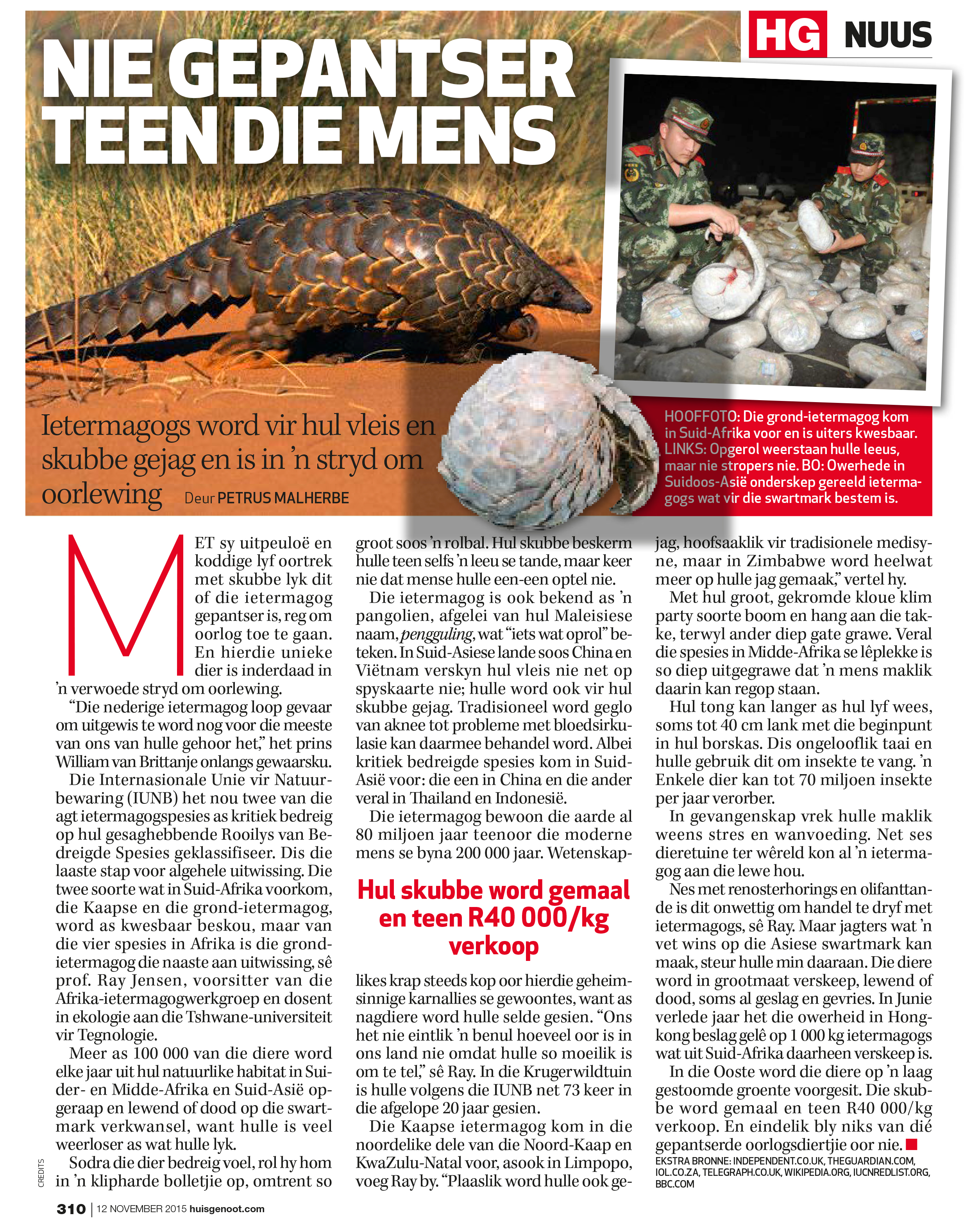
Die grond-ietermagog. Dié Suid-Afrikaanse spesie is een van die agt wat in die wêreld gevind en ernstig bedreig word.
Die lewe van die ietermagog, ’n skubberige, skugter soogdiertjie, hang aan ’n draadjie.
So het die Wêreldbewaringsunie (IUCN) Dinsdag gesê toe dié organisasie sy jongste rooidatalys bekend gestel het.
Luidens die lys is die status van die agt spesies ietermagog wat in die wêreld aangetref word nou kwesbaar.
Prof. Ray Jansen van die departement omgewing-water- en aardwetenskappe aan die Tshwane-Universiteit van Tegnologie (TUT) het Dinsdag gesê die ietermagog het opgeskuif van “byna bedreig” tot “kwesbaar”.
“Dit beteken die ietermagog is byna op die rand van uitwissing.
“As buitengewone bewaringsmaatreëls nie dringend ingestel word nie, kan dié diertjies binne die volgende 15 jaar – of selfs vroeër – uitsterf,” het hy gesê.
Die IUCN het gesê die ietermagog word letterlik deur Oosterlinge en Asiate opgeëet. Dié organisasie wys daarop dat die ietermagog die enigste soogdier ter wêreld is wat met skubbe gepantser is. “Die skubbe is sy wapenrusting teen natuurlike vyande, maar dit bied geen beskerming teen stropers nie.”
Met meer as 1 miljoen van die diere wat die afgelope dekade onwettig uit die natuur verwyder is, maak dit van hom die wêreld se mees gestroopte dier, selfs meer as olifante en renosters, sê die IUCN.
Geregte met die vleis van die ietermagog is veral gesog onder welgestelde Asiate en Chinese.
Sommige Chinese glo ook dat die skubbe van die ietermagog medisinale eienskappe het en dat dit byvoorbeeld help om ’n swak bloedsomloop te verbeter.
Die IUCN wys daarop dat vier spesies ietermagog wat vroeër in Asië voorgekom het, byna uitgesterf het en dat stropers en onwettige handelaars Afrika nou binnegevaar het om die diere hier te kom stroop.
Jansen het gesê net een van die agt spesies ietermagog, die grond-ietermagog, kom in Suid-Afrika voor.
Hoewel die grond-ietermagog nog nie in massiewe hoeveelhede gestroop word vir die markte in die Ooste nie, is die moetie-handel en elektriese wildheinings dié diere se grootste vyande.
Volgens Jansen is die Afrika-ietermagog-werkgroep onlangs in die lewe geroep om onder meer bewusmakingsveldtogte oor die diere se lot van stapel te stuur.
Hy doen die afgelope vier jaar navorsing oor dié soogdiere en sê niemand in Suid-Afrika weet wat hul bevolkingsgetal is nie.
“Ons is besig om hulle te tel.”
Jansen het gesê deurdat die diere so skugter is en net snags uitkom om te vreet, is daar mense wat hulle in hul hele leeftyd nooit sal sien nie. Hulle het vroeër aan die Weskus- en Oos-Kaap voorgekom, maar het daar heeltemal uitgesterf. Hulle kom nou meestal in die noordelike dele van die land voor.
The following article appeared in the Afrikaans medium newspaper Beeld:
Unieke ietermagog se stryd omoorlewing
Die skaars en bedreigde ietermagog kan selfs ’n nuuskierige leeu afskud, maar geelektrifiseerde wildheinings maai hulle steeds af, skryf Eben Human.
Die ietermagog is die enigste soogdier wat homself met skubbe beskerm.
Daar is vier soorte in Afrika en nog vier in Indië en elders in die Ooste.
’n Mens sal hom selde sien – selfs nog minder as ander nagdiere soos die erdvark en die springhaas, wat jy in dieselfde gebied vind.
Gesels jy met ’n navorser soos Darren Pietersen van die Universiteit van Pretoria, kom jy agter die ietermagog is nie heeltemal so skaars soos jy eers vermoed het nie. Pietersen is betrokke by werkgroepe wat oplossings soek vir die bewaring van die ietermagog.
Hy werk tans in die Kalahari, waar hy dikwels sien hoe ietermagogs deur wildheinings doodgeskokword . Stropery, veldbrande en insekdoders is ander bedreigings, maar Pietersen werk hard aan planne om’n oplossing te vind met ’n beter ontwerp vir die wildheinings.
’n Ietermagog kan ’n leeu afskrik wanneer hy hom oprol, maar loop hy met sy sensitiewe maaggedeelte in so ’n elektriese draad vas, is dit ’n ander storie. Hy reageer instinktief en rol hom op om die draad, waar hy dan dood aangetref word. Die elektriese stroomvan die heining kan 7000 volt en meer wees. Al is die stroom nie so sterk nie, kan die ietermagog van blootstelling en verhongering vrek terwyl hy opgekrul aan die draad hang.
“Ons kyk nog na die ideale ontwerp van so ’n heining waarmee ons kan keer dat ’n ietermagog onnodig doodgemaak word,” het Pietersen gesê.
My indruk was nog altyd dat die ietermagog ’n baie klein dier is. Pietersen wys daarop dat hulle in dieKalahari gemiddeld 10 kg kan weeg en in die Bosveld 15 tot 18 kg.
Vir haar boek Aardwolf tot Ystervark – Vrae en Antwoorde het Riëtte Conradie van Struisbaai ook gaan kyk nawaar die ietermagog se naam vandaan kom.
In Engels heet hy pangolin, en dit is afgelei van die Maleise woord peng-poling, wat verwys na sy vermoë om hom op te rol. “Ietermagog” is egter afgelei van Tswana se macho-cho, wat “mier” beteken, terwyl magogwe die woord vir “ratel” is.
In Conradie se boek word daarop gewys dat die ietermagog se skubbe ’n ondeurdringbare skild vorm wat hom selfs teen hiënas en luiperds beskerm – wat hom soms vang. Die skubbe en die vel vorm tot ’n derde van die dier se totale massa.
Die ietermagog se dieet bestaan hoofsaaklik uit miere. Hiervoor het hy ’n baie lang tong. Die Afrika Ietermagogwerkgroep, waarvan Pietersen
die voorsitter is, is besig met verskeie navorsingsprojekte. Van hierdie diere is al van ’n sendertjie voorsien om hul bewegings deeglik te monitor.
Pietersen en ’n mede-navorser, prof. Ray Jansen, lei van die navorsing omonder meer te kyk na die verspreidingsgebiede van Afrika se
ietermagog-spesies. Die ietermagog word al byna as ’n mitiese dier beskou omdat hy so min gesien word.