The following article appeared in Wired magazine, in print and online on October 10, 2020. It was written by Sabrina Weiss and the photos are by Julien Faure. The original article can be found here
Pangolin scales are a prized ingredient in traditional Chinese medicine – and that has put the animal firmly on the endangered list. Isoscape tracking could help stop their slaughter at the source
Pangolins are thought to have passed the coronavirus to humans, after they first caught it from horseshoe bats
Before researchers suggested pangolins may be a missing link in the transmission of coronavirus from bats to humans, most people had never even heard of them. Yet these scaly, ant-eating mammals are smuggled in huge numbers to Asia and are in danger of extinction.
There are eight species of pangolin, split evenly between Africa and Asia, and each one of them is barred from international trade. So identifying confiscated scales and body parts as “pangolin” can be enough to prosecute a criminal case. But discerning different species and tracing their geographic origins is more tricky. This is where wildlife forensics comes in, a rapidly developing field that uses scientific procedures to investigate crimes against wildlife. To help crack down on intricate trafficking routes and poaching hotspots, scientists and laboratory technicians are figuring out ways to analyse the DNA and dietary history of seized animals and their products.
Pangolin scales are a booming business in Asia thanks to their status as an ingredient in traditional Chinese medicine, while the animal’s meat is considered a delicacy Julien Faure / INSTITUTE
Most consumers come from mainland China and Vietnam, where pangolin meat is a prized delicacy and keratin scales are a popular ingredient in traditional Chinese medicine, touted as a cure for anything from asthma to cancer, and as an aid to help mothers with lactation. Pangolins have recently been in the spotlight for their potential role in the Covid-19 pandemic. Sars-Cov-2, the virus that causes the novel disease, is suspected to have originated in horseshoe bats and possibly leaped to humans via pangolins.
Dear Dr Tedros Adhanom Ghebreyesu (Director General of the World Health Organisation) and
Ms Inger Andersen (Executive Director of the United Nations Environment Program),
STATEMENT ON NOVEL CORONOVIRUS (COVID-19) PANDEMIC AND A RESPONSE TO THE CALL ON THE TOTAL BAN ON GLOBAL “WET MARKETS”
Preamble
Humanity is under siege from a global viral pandemic. We, as a global community, have been through a number of these, many of which have changed the course of history and life as we know it. The current one, commonly referred to as COVID-19, will undoubtedly do the same. Its origin is mainland China – a country not new to catastrophic viral pandemics, recorded as early as 5000 years ago in “Hamin Mangha” and at the same time in “Miaozigou”, both in north-eastern China. Of more recent historical occurrence was the great flu pandemic of 1889, the Spanish Flu of 1918, the Asian Flu of 1957 (also originating from China), and more recently the H1N1 swine flu of 2009 and the ongoing Ebola epidemic. All seem to have a common thread – their origin was very likely a zoonotic infection where the virus was transferred, through a mutation event, from an animal to a human. COVID-19 was a similar event and a similar viral strain had occurred as SARS-CoV in 2002/3 in Guangdong Province, China and SARS MERS in 2012 in the Middle East. Like COVID-19, both were SARS (severe acute respiratory syndrome) viruses, both seemed to have originated from a common ‘natural’ host and both were unleashed through human utilisation of wild animals for consumption. It is now time that humanity ensure systems and processes are in place to protect both human populations as well as the world’s free-living wild animals and the natural spaces and ecosystems they occupy to benefit all living entities that share this planet.
Currently, there are two dominant schools of thought – one is to have a complete ban on global “wet” markets; the other to impose intense regulation measures within these markets on the animals traded so as not to be to the detriment of human communities and, to a lesser extent, wild animal populations. The first is unrealistic and the second would be almost impossible to regulate. In this open letter, we provide a simplistic summary of the virus, its transmission to humans, our view on a global ban of wet markets and a suggested compromise to both.
The origin and source of COVID-19
SARS or Coronaviruses are a diverse family of viruses with their most likely origin in a natural host species, often bats. Their name originates from the spiky projections on their outer surface that take the shape of a “crown”. Within the natural host, the virus is benign and cannot infect humans. However, the virus has an uncanny ability to mutate and, once it does, the molecular makeup of its binding surface changes and may be compatible with an alternative host that has come into close contact via the spread of blood or body fluid like excreta; or is a species that has preyed upon the natural host. These new (intermediate) hosts were an Asian civet species in the 2002/3 SARS outbreak in China, camels in the 2012 MERS outbreak in the Middle East and pangolins have been unproven accursed with this current SARS outbreak.
For the SARS virus to jump to an intermediate host in a wild natural environment is uncommon, although not impossible. For the SARS virus to be transmitted to an intermediate host via (forced) close contact is more likely and pretty much inevitable. These environments are created by humans in markets where animals are held in unsanitary conditions; welfare is minimal and manifold in species that are in close contact with one another, often slaughtered in what is termed a “wet” market environment. This is a cesspool of disease and is the epicentre of the vast majority of viral outbreaks that infect human populations and emanate from the direct, and often, inhumane utilisation of both wild and domestic animal species.
Transmission to humans
It is widely believed a SARS virus, carried by a species of Horseshoe bat, was passed on in a mutated form to an intermediate host in a wet market in Wuhan, central China, during 2019. The intermediate host species is unknown, however, an Asian species of pangolin was implicated. Either through indirect contact, direct contact of some sort or through consumption, this novel Coronavirus was transmitted to humans and COVID-19 spread like a wildfire across the globe hitching rides on human carriers primarily through rapid global air transport. It is abundantly clear that a future risk assessment strategy and a realistic action plan needs to be formulated urgently.
The total ban on wet markets OR the overregulation of these markets
In principle, inhibiting the spread of dangerous future zoonotic diseases is relatively simple – close down all wet markets. In reality, this is both not possible nor would it be sympathetic to the many millions of people around the world that rely on the utilisation of countless species of both plants and animals for their existence as a source of food and as an advantage in job creation amongst many other outcomes.
Both arguments have been clearly stated in open letters to you by well recognised animal welfare organisations and academics from various sources. Intense regulation in very remote rural communities, and associated wild food markets, in Africa and Asia (primarily) is also not practical nor realistic as the funding, manpower and social urgency does not exist and will not exist for a multitude of reasons. The cultural existence and long history of the utilisation of natural resources cannot be outlawed and set into law within societies that are many thousands of years old with strong cultural and traditional value systems. Many of these activities will simply continue unabated or even move underground and the welfare of animal species will likely deteriorate further and the likelihood of a disease outbreak will be even greater.
Proposed way forward to inhibit the spread of future zoonotic diseases
Zoonotic diseases such as SARS Coronoviruses, Ebola, AIDS, Swine Flu and a multitude of other viruses involve a very specific group of vertebrate terrestrial mammals being kept under conditions where their welfare is compromised and in close proximity to other wild and domestic animals that are being utilised by humans for consumption. This is the ideal climate for both host and intermediate host virus transmitting species.
Firstly, the consumption of predatory terrestrial and semi-terrestrial carnivores, insectivores, a small group of omnivores and a smaller group of frugivores are primarily responsible for a large percentage of these outbreaks or, at least, the initial origin and source of these outbreaks. These include but are not limited to the Felidae, the Canidae, the Manidae, bats, primates, civets, and others (to be identified by WHO appointed epidemiologists) where viral zoonotic epidemic risk is considered very high and likely.
Secondly, inhumane conditions relating to animal welfare, husbandry and close confinement leads to a compromised immune system and play a considerable role in both the origin and transmission of these highly contagious zoonotic viral diseases. Guidelines on humane animal welfare have been developed by a multitude of organisations and can be implimated with little additional cost or effort.
Implementation of regulations relating to both the above is realistic and achievable for the benefit of the welfare of humans and a multitude of vertebrate species that are often regarded as key species in terrestrial ecosystems. The identification of these species (representing animal orders) can be rolled out to communities via visual pamphlets, social media and general media. It is pertinent to mention that current laws relating to protected species within range states are generally and most often ignored. The process of publically identifying certain “groups of species” (Orders) is expected to be more acceptable than providing endless lists of protected species in countries such as Africa and Asia. Mechanisms of communication to even very remote regions have been proven to be very successful recently in a multitude of Asian and African countries with regards the further spread of COVID-19. Similar communication methods can be implemented in the prevention of the use of species identified as high-risk in the potential spread of zoonotic viruses.
These proposed regulations are achievable and will reduce the risk of further epidemiological pandemics considerably whilst ensuring the well-being of species in these markets as well as the humans that depend on these species for survival. This is by no means a definitive ‘recipe’ to the issue at hand but an initial realistic proposal to the benefit of all who are at risk.
Professor Ray Jansen Chairman of the African Pangolin Working Group On behalf of the African Pangolin Working Group
Use of pangolins for bushmeat and African traditional medicine, particularly in poor communities, is complicated by the growing, unsustainable demand for scales from Asia. Alexis Kriel investigated for Oxpeckers.org
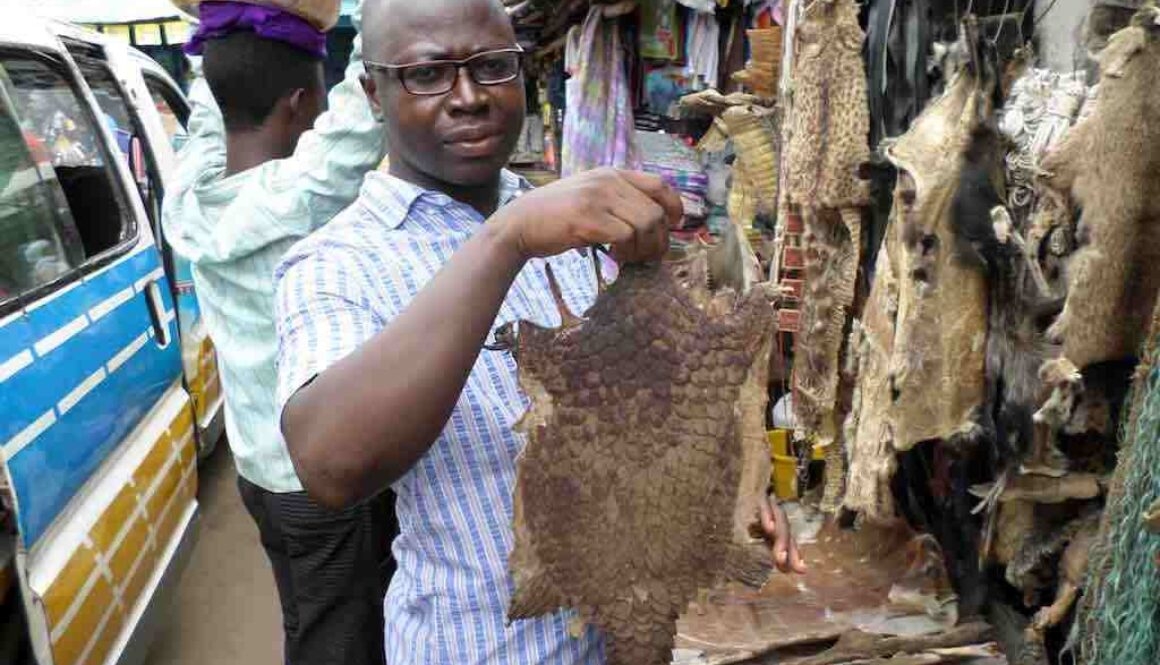
(Pictured above: A full pangolin skin with all the scales intact, for sale in an African ‘muthi’ market. Photo courtesy African Pangolin Working Group)
A spirited video clip of martial arts guru Jackie Chan and three animated Kung Fu pangolins sends a strong message to Chinese consumers that these animals are protected by law. The clip ends as the heroic pangolins assist Chan in dumping a poacher in the trash and a tagline that has become synonymous with these celebrity-driven campaigns: “When the buying stops, the killing can too.”
WildAid, which conducts extensive surveys to calculate positive behavioural change, says campaigns like this have helped reduce shark fin sales in China by 80% since 2011.
To raise public awareness about the illegal wildlife trade, the organisation has enlisted more than 100 celebrities, including Prince William, David Beckham and Richard Branson. Its ambassador for the shark fin campaign was Yao Ming, a retired professional basketball player who is one of China’s best-known athletes.
According to Peter Knights, WildAid’s founder, these campaigns have helped to reduce the global consumption of wildlife products, with ivory sales down by more than two thirds in Asia, by a third in Kenya and cut in half in Tanzania from 2017.
For pangolins, however, curbing consumption is harder, says Knights, particularly since the scales can be sold legally in China for traditional medicine through state-authorised hospitals.
In 2016 all eight species of pangolin were listed on Appendix I of the Convention on International Trade in Endangered Species (CITES), making international trade in them illegal. But that does not stop China from trading them domestically.
China’s annual domestic use amounts to roughly 25 tons of pangolin scales for medicinal purposes – the equivalent of up to 50,000 pangolins, according to the China Biodiversity Conservation and Green Development Foundation.
With Asian pangolin populations under pressure from poaching and habitat loss, these mammals are being sourced elsewhere. Since the beginning of 2019 customs officials have confiscated more than 50 tons of African pangolin scales en route from Nigeria to Asia.
Knights believes the most powerful actions for protecting pangolins worldwide would be for Chinese traditional medicine associations to remove pangolin scales from their pharmacopeia and for China to ban domestic use of scales and promote existing alternative treatments, as it did for rhino horns.
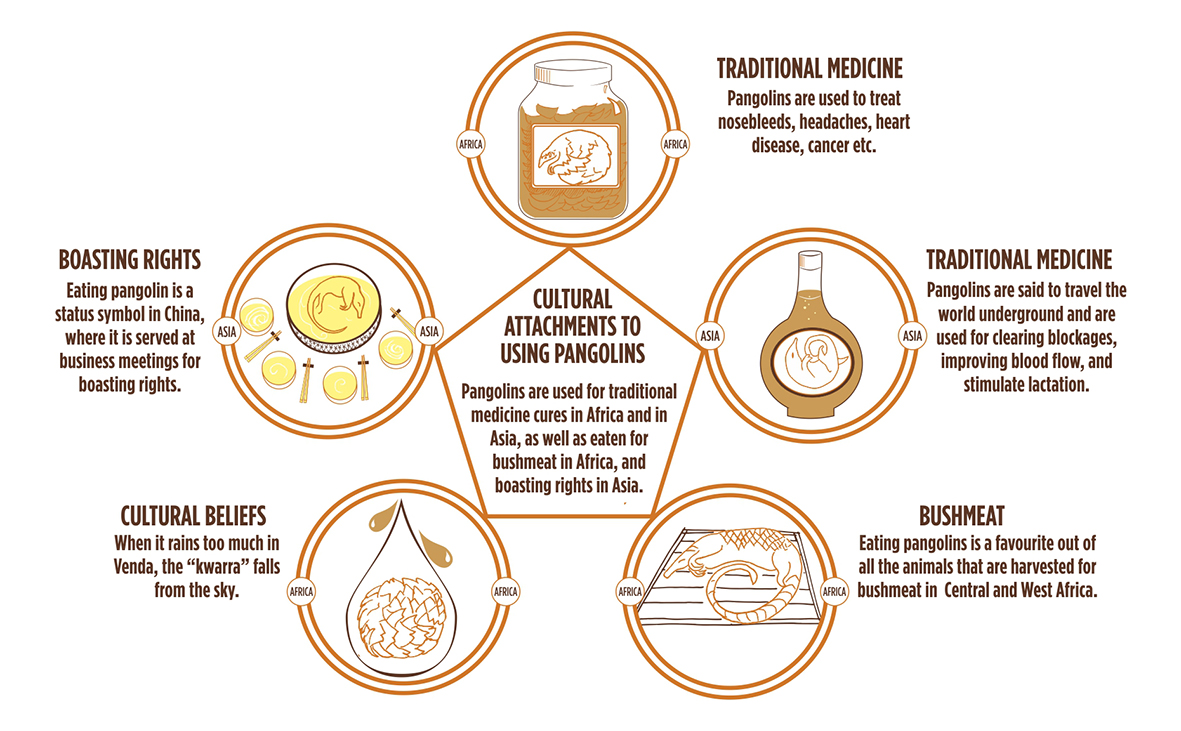
Pangolins used as a commodity in cultural belief systems and for food is driving this species to extinction. Graphic: Lori Bentley
Behavioural change
Knights is currently travelling in Africa, where WildAid’s “behavioural change” campaigns have started rolling out. Similar to the successful Asian film clips, these campaigns use local celebrities, such as athlete Eliud Kipchoge of Kenya, actress Anne Kansiime of Uganda and Springbok rugby player Tendai “Beast” Mtawarira of South Africa, under the banner “Poaching steals from us all”.
He says WildAid’s emphasis in Africa is on promoting sustainable tourism, encouraging local people to visit their national parks and for there to be greater value in wildlife tourism as opposed to poaching. These campaigns have been specifically adapted to the African context, with a strategy to reduce human-wildlife conflict and encourage public and political support for conservation.
There is a very real threat to pangolin populations at the current level of use – for bushmeat and African traditional medicine (muthi), particularly in poor, under-resourced communities. This demand is specific to the trade in Africa but complicated by the growing, unsustainable demand for pangolin scales from China.
According to the World Health Organisation (WHO), traditional medicine is the first level of contact many people in developing countries have with healthcare due to inadequate modern medical facilities and affordability when these are available. The WHO estimates that 80% of Africa’s population uses traditional medicine either on its own, or in combination with Western medicines.
Malokisa Mukondeleli, who grew up in King Toni Mphephu Ramabalana’s royal compound at Dzanani Khoroni in Venda, says she remembers how pangolins were sometimes brought to the royal compound and gifted to the king. Photo: Alexis Kriel
Traditional medicine
In South Africa, the Temminck’s ground pangolin is available in traditional medicine markets and is promoted as a treatment for a range of ailments, including nose bleeds, headaches, heart disease, chicken pox, epilepsy, cracked heels, spiritual aliments, infertility and cancer.
Professor Ray Jansen, chairperson of the African Pangolin Working Group, has studied the ethnomedicinal and ethnozoological uses of African pangolins by traditional medical practitioners. He emphasises the need for conservation efforts aimed at educating traditional healers on the implications of unsustainable harvesting of wild pangolins – for medicine and the illegal wildlife trade – and the potential threat posed to cultural belief systems if the animals are no longer available.
“In some South African tribal societies, the pangolin is revered,” says Jansen. There is no concept of extinction in African traditional belief systems, and this can make conservation efforts difficult, he says.
The Venda and Tswana clans living in the northern regions of South Africa have special songs they sing when the animal known as “kwarra” (pangolin) is sighted, and whoever initially spots the creature is accorded special treatment by the chief and tribesmen
Malokisa Mukondeleli, who grew up in King Toni Mphephu Ramabalana’s royal compound at Dzanani Khoroni in Venda, says she remembers how kwarra were sometimes brought to the royal compound and gifted to the king.
Zwivhuya Mpho, my translator, explains further how pangolins were not allowed to be hunted – a local tradition holds that when it rains too much, the kwarra falls from the sky and whoever finds it must bring it to the king.
“No one is permitted to kill or eat the kwarra except the virgin boys and girls in the compound and the old people, or a drought will befall the land,” he says.
The “kwarra appears only when it wants to”, says Chief Rapson Davhana Matamela, explaining that a sighting is an extremely lucky occurrence. Speaking from the garden of his house in a rural village in Venda, he says he hasn’t seen a pangolin for 28 years, but still he struggles to understand that there is a poaching problem.
When shown a picture of bags of African pangolin scales confiscated in Asia, Chief Matamela reacts with shock. If anyone is caught trading in pangolins in Venda, he says, he will call the police.
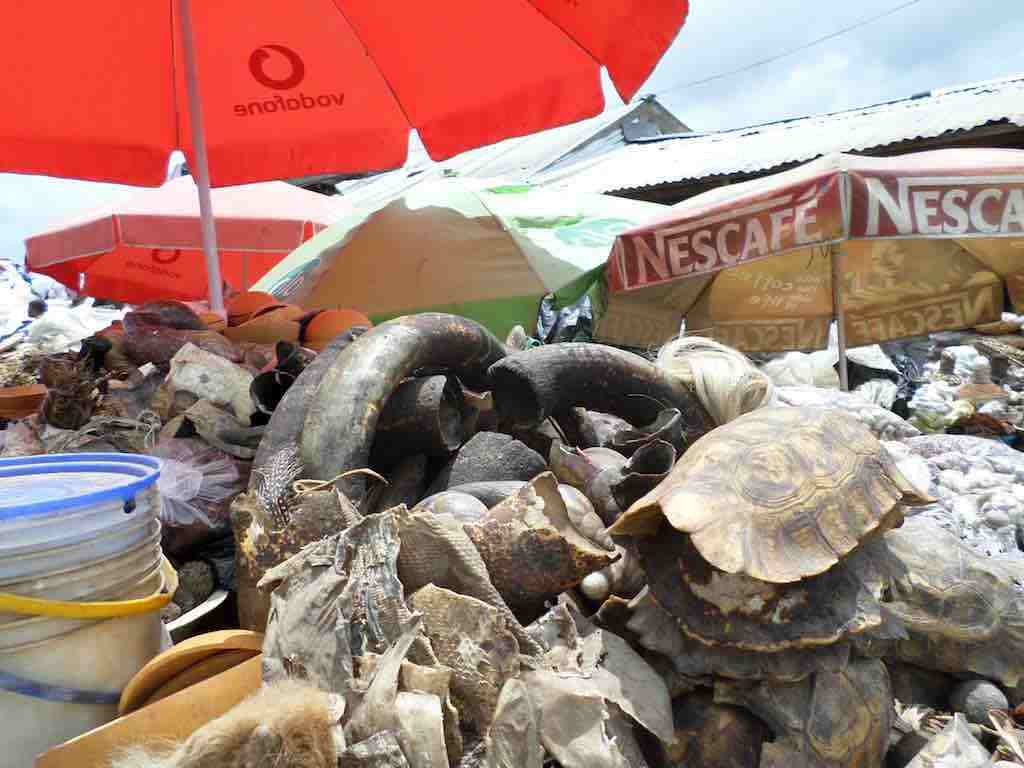
A pile of animal body parts used in traditional African healing. Asian buyers are increasingly infiltrating customary outlets. Photo courtesy African Pangolin Working Group
Western-style policing
For now, Jansen believes that Western-style policing is not as powerful a deterrent against poaching as a command from tribal leaders. But their ability to influence behaviour in their communities may be diminishing among a younger generation that Jansen says has developed a “proclivity to a Western way of life and a culture of making money”. Where traditional practices are ridiculed for being “sympathetic magic” and superstitious belief, a component that has helped protect the pangolin is being lost, says Jansen.
In African countries where these animals are not revered as totems of the spirit world, they face threats from unregulated harvesting and poaching for bushmeat.
According to Dr Maxwell Boakye – a doctoral student of Jansen and the author of a study unravelling the bushmeat commodity chain in Ghana – pangolins are the most preferred wildlife species for festive meals among the wealthy in West and Central Africa and are consistently hunted.
A Nigerian businessman, Omotolani Adeyemi, says he will “never stop eating pangolins” because he loves bushmeat. He laughs when asked about the threat of species extinction.
However, it is the massive demand for pangolin scales in Asia that poses the greatest threat to the African pangolin population. In his study, Boakye also shows how rural bushmeat markets, or “chop bars”, that originally sold harvested pangolins for food are now doubling up as collection points for pangolin scales used to supply the illegal trade to Asia.
The same is true for muthi (medicine) markets, where Asian buyers are increasingly infiltrating customary outlets and local merchants are becoming trading agents.
Dr Vivienne Williams, an independent researcher at the University of the Witwatersrand who specialises in African traditional medicine, views the international wildlife trade as a multi-faceted Rubik’s cube, where solving all sides of the problem in a logical and persistent manner is necessary.
“Most conservation problems are embedded in complex socio-ecological systems, and they essentially lack clear solutions because each problem is linked to other problems,” she says.
Venda women respectfully greet their chief, Rapson Davhana Matamela, in traditional fashion. Photo: Alexis Kriel
Extreme poverty
Poverty is one such problem helping drive the illegal wildlife trade. Vusi Mathe lives in a poverty-stricken rural settlement called White City in Mpumalanga, 800m from the Andover Nature Reserve, marketed by the Mpumalanga Tourism and Parks Agency (MTPA) as “an unspoiled wildlife area”.
But Mathe says extreme poverty has led the locals to hunt game in the reserve for food and he doesn’t think much wildlife is left there. “I know a lot of people who are poaching for bushmeat in the reserve because they are poor. I have never done it, but I have thought about it,” he says.
Andover is 100% under land claim, which is the restitution of land rights for the dispossessed original owners. But local residents don’t feel they have a stake in the local wildlife and tourism economy. Unemployment in the area is currently at 52%, according to the MTPA, and there are few economic opportunities outside of the reserve.
In an article published on Ranger Day in April, John Scanlon OBE, who served as the secretary-general of CITES from 2010 and is now special envoy for African Parks, points to Garamba National Park in the Democratic Republic of the Congo, where poaching is down by 98% over the past two years due to a well-trained ranger force that has created a sense of law and order and brought security and stability to Garamba and its surroundings.
“It is about securing an area for wildlife and people through well-trained rangers, who can apply law and order with the strategic use of fencing – to keep animals in and away from people and their crops – to engage with and provide decent jobs to local people and to support local enterprise via the likes of tourism and the marketing and the consumption of local produce,” he tells Oxpeckers.
Williams believes it is urgent and essential for “sites in African countries to be identified for strict protection of pangolins, with only the controlled salvage of pangolins that have died a natural death being permitted for use in traditional medicine.”
She says “non-consumptive cultural belief systems” should be supported, and communication should be fostered for amplifying African voices and finding unique solutions.
In parts of southern Africa, for example, traditional medicine practitioners only use a few grams of pangolin scale powder when dispensing to a patient, says Jansen.
“The pangolin power is used for a variety of medical or spiritual conditions and these healers do keep a few scales in their inventory of local herbs and animal body parts at any one time.” But, Jansen adds, “these scales can last a number of years due to the very low volumes dispensed.”
The original article in Oxpecker.org, can be found here
The following article was published by ABC news from the Associated Press.
JOHANNESBURG — As World Pangolin Day is marked around the globe, Saturday, some conservationists in South Africa are working to protect the endangered animals, including caring for a few that have been rescued from traffickers.
The eighth annual pangolin day is celebrated to raise awareness about the shy, nocturnal scaly anteater, which some wildlife organizations say is the world’s most trafficked animal.
In South Africa, traffickers often sell the pangolin meat locally and ship the scales to Asia, where they are in demand for use in traditional medicine. The growing illegal trade has prompted plans in South Africa for a rehabilitation center for sick or rescued pangolins as well as the deployment of sniffer dogs specially trained to detect the scales’ pungent aroma.
Africa’s four species of pangolins are under increasing pressure from poachers because Asia’s four species have been decimated, according to experts. While commercial trade in all eight species is forbidden, international confiscations of African pangolin scales amounted to about 47 tons in 2017, more than double the quantity seized in the previous year, said the African Pangolin Working Group, a conservation organization based in South Africa.
Dogs have been trained to check for hidden pangolin scales at South African borders and there are plans to create a “pangalorium” — a research and medical center for pangolins, including the growing number of live animals seized in sting operations.
Pangolin scales contain keratin, a protein also found in rhino horn and human fingernails. There is no scientific proof that they provide any medicinal value. Conservationists say well over 1 million pangolins have been poached since around 2000; the various kinds range from vulnerable to critically endangered on a list of threatened species.