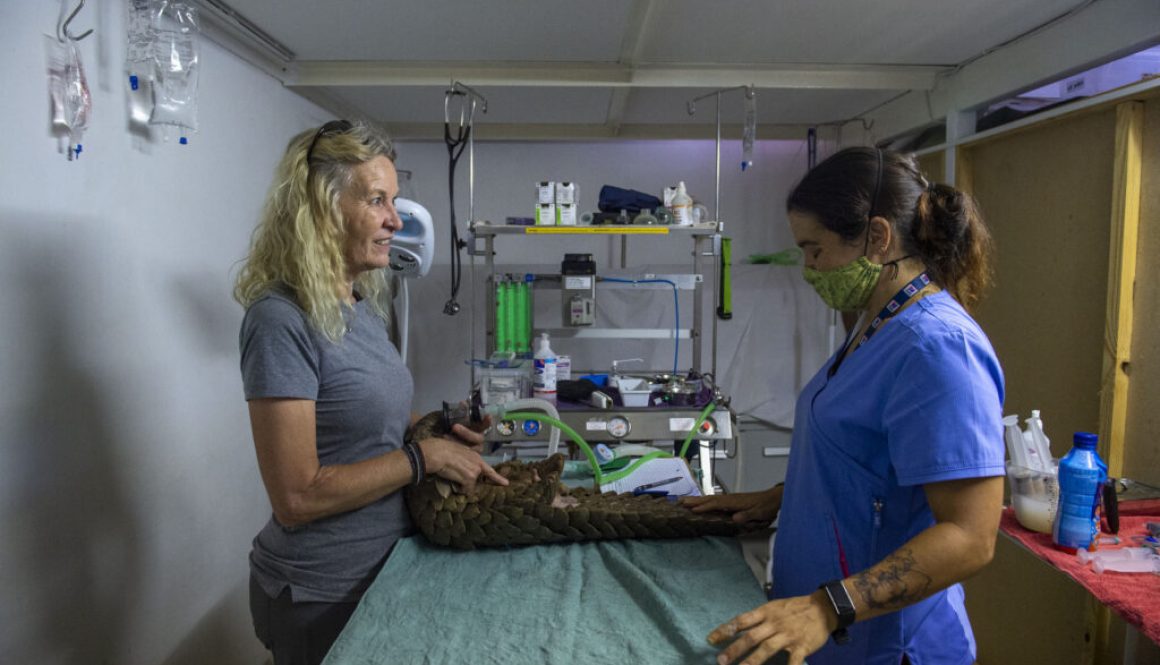
The Democratic Republic of Congo is Africa’s second largest country covering 2 345 million square kilometres. With its tropical rain forests and tropical savannahs, it is considered the most biodiverse country in Africa. While most conservation efforts in the country have been focussed on the endemic great ape species, there is a growing concern for pangolins due to the illegal wildlife trade. The DRC is home to three of the four African pangolin species: giant pangolins, white-bellied pangolins and black-bellied pangolins.
Since its inception, the African Pangolin Working Group has forged relationships with local stakeholders on the ground in several locations across the country, and our rehabilitation experts have advised, supported and funded pangolin rescues. Most of them have been behind the scenes operations, with the occasional rescue story too eventful not to share.
Why travel to the DRC?
When Dr Kelsey Skinner joined the team this year, she arrived fresh from two years working within Vietnam, a global pangolin trade hotspot. Her work focused on capacity building for pangolin rescue and rehabilitation, guiding multiple local and other continental conservation groups on best practice protocols. Imparting her knowledge of the very specific needs of traumatised pangolins and finding practical ways to achieve this goal, left a legacy that will continue to grow.
Recent high numbers of remote rescues have put the team further in touch with conservationists and vets in Kolwezi, Kinshasha, and As a result, Dr Kelsey and co-chair Nicci Wright are planning a two week trip to the DRC to meet up with these contacts and gain a deeper understanding of the conservation challenges they face, and investigate ways to provide support in partnership, working from a well-rounded and effective background of pangolin conservation model knowledge in South Africa and Vietnam
We will report back and let you know how YOU can help with this work in the near future.
“One individual cannot possibly make a difference, alone. It is individual efforts, collectively, that makes a noticeable difference – all the difference in the world!” Jane Goodall
You can make a small difference now
Dr Kelsey has been nominated for the the Worldwide Vets Golden Star Award for 2025. The winner is chosen by public vote which is open from 20 October – 13 November, with the top 10 finalists being announced on November 14.
Dr Kelsey’s unwavering commitment to conserve pangolins continues to inspire us all. Her continued veterinary excellence and compassionate care, for all animals here in South Africa, as well as beyond our borders makes her a worthy recipient that we are proud to have as part of our team.
We are proud to announced the opening of our state-of-the-art pangolin veterinary and rehabilitation facility within the pristine Lapalala Wilderness Reserve, on World Pangolin Day – February 15th, 2025.
APWG co-chair Alexis Kriel addresses the gathered guests
The inauguration event, held over the course of the weekend, marked a significant milestone in the conservation efforts for Temminck’s pangolin, in South Africa, and for the APWG.
Guests entering the Pangolarium for the first time; APWG founder Prof Ray Jansen gets a guided tour from co-chair Nicci Wright; Lunch in the lapa after the opening
Guests included conservationists, representatives from environmental organisations, ecologists, and scientists, all united in their support for the APWG’s ongoing contribution to pangolin conservation in South Africa. Lapalala Wilderness Reserve, spanning approximately 48 000 hectares in Limpopo province, within the UNESCO designated Waterberg Biosphere, offers an ideal environment for pangolin rehabilitation. The reserve’s diverse ecosystems and state-of-the-art security ensure that rehabilitated pangolins have the best chance for a successful reintroduction back into the wild.
The team that made it all happen: Kate Hughes (Lepogo Lodges); Nicci Wright and Alexis Kriel (APWG co-chairs); Glenn Phillips (CEO Lapalala Wilderness); Gareth Thomas (APWG) and Prof Ray Jansen (founder and past chair APWG)
The Pangolarium (meaning a “place for pangolins”) is a purpose-built facility that aims to enhance the rescue, veterinary high care, rehabilitation, and reintroduction processes for pangolins rescued from the illegal wildlife trade on the west side of Limpopo Province, also accessible from the north of the province, and with a doorway into North West Province. Equipped with advanced medical and husbandry resources, the centre provides a facility where this vulnerable species can recover and prepare for a return to their natural habitat. It will also serve as a basecamp for the APWG’s ongoing research and education initiatives.
The building of the facility has been financed by Lepogo Lodges – an NGO Lodge operator on Lapalala Wilderness Reserve and the Sustainability winner of the Ahead Travel Awards, for Melote House, in the MEA division.
Limpopo Province is historically the province with the highest incidence of pangolins retrieved from the illegal trade, sharing borders with Zimbabwe, Mozambique, and Botswana – all pangolin range countries – where transboundary collaborators facilitate the poaching and sale of pangolins in South Africa. Pangolins are currently considered the most illegally trade non-human mammal on the planet, with the eight species (four in Africa and four in Asia) varying from vulnerable to endangered on the IUCN Red List, and with all populations decreasing. They have been resident on earth for 85 million years.
The APWG invites the global community to join in supporting our pangolin conservation efforts. For more information on how to contribute or get involved, please visit our donations page.
On 17 September, 2019 at Silver Oaks, Pretoria, members of the Cullinan Stock Theft & Endangered Species Unit, assisted by members from K9 Benoni, Silverton and Law Enforcement Officials from the Gauteng Department of Agriculture & Rural Development also known as the Green Scorpions, and members of the African Pangolin Working Group conducted a sting operation in which a pangolin was offered for sale to an undercover agent.
Four suspects were subsequently arrested and the vehicle they had used to transport the pangolin was seized. At the time of the arrest, the female pangolin was still alive but severely dehydrated and badly compromised. The pangolin died a few days later at the Johannesburg Wildlife Veterinary Hospital due to malnourishment, dehydration and various physical injuries sustained during captivity. The pangolin had suffered severely while it was kept in captivity as its bones and tendons were clearly visible due to emaciation.
Charges
Charges against two of the four suspects were withdrawn by the Director of Public Prosecutions, Pretoria due to insufficient evidence to prove their involvement. Advocate Jeff Nethononda from the Director of Public Prosecutions, Pretoria office, prosecuted the case in the Pretoria Magistrate’s Court where the presiding magistrate was Ms Luut. The investigation led by Sergeant Morné Kemp from Cullinan Stock Theft & Endangered Species Unit, worked hand in glove with the National Prosecution Authority (NPA) to secure a successful prosecution and conviction.
Professor Jansen, attached to the Faculty of Science at the Tshwane University of Technology in Pretoria, and the founder and Chairman of the African Pangolin Working Group, testified in aggravation that the illegal trade in pangolins makes them the world’s most trafficked mammal. Professor Jansen testified that pangolins are ant eaters, have no defence mechanism and are totally harmless. He further testified that pangolins, globally, are critically endangered and close to being extinct in the near future.
Sentencing
On March 15, 2021, the 2 accused were found guilty and sentencing handed down by the Pretoria Magistrate’s Court on May 19, 2021 as follows:
Accused 1: Orateng Mekwe, a South African citizen, was sentenced to 10 years direct imprisonment without the option of a fine for Contravening Sec 57(1) of National Environmental Management Biodiversity Act 10 of 2004 and for carrying out a restricted activity pertaining to the illegal trade of Pangolins.
Accused 2: Jealous Rungano, a Zimbabwean citizen, was sentenced to 3 months imprisonment and to be deported back to Zimbabwe i.t.o Sec 49(1)(a) of Immigration Act 13 of 2002.
They were both declared unfit to possess a firearm i.t.o Sec 103 of the Firearms Control Act 60 of 2000. Application for leave to appeal was granted.
A clear message
Part of the magistrate’s judgment was that a clear message must be sent to poachers that the illegal trade of wildlife will not be tolerated, just like rhinos, the pangolins and all other wildlife species need to be protected for future generations to appreciate.
The NPA welcomed the sentence as it is the highest sentence ever imposed upon conviction of pangolin poaching in South Africa.
The African Pangolin Working Group’s Chairman, Professor Jansen says that this sentence not only sets a South African and an African continental precedence but also a global precedence for the highest jail sentence given to a pangolin poacher.
We are always blown away by the generosity of people who discover pangolins and decide to join the struggle to stop them being wiped off the face of the earth. Gillian Condy is one such person.
Born in Kenya, Gillian went to primary school in Uganda before her family moved to the UK. There, she received her Masters in botanical illustration from the Royal College of Art, London. Africa worked its special magic and she returned to work for International Voluntary Services and Dept. of Education in Botswana before being offered a job by The Botanical Research Institute, now the South African National Biodiversity Institute as the resident botanical illustrator. This was a job she would hold for 34 years before retiring.
Gillian has been an active freelance artist for 40+ years and teacher for 25, with over 140 international exhibitions and a string of awards to her name. She has illustrated botanical books and designed postage stamps for Botswana and South Africa. She is a member of the South African and American Botanical Artists Associations.
Artist in Residence in pangolin country
In November 2017, Gillian was appointed ‘Artist in Residence’ at the Tswalu Kalahari Private Nature Reserve and made eight trips to the reserve to illustrate the plants over the next 14 months. In addition to plants, Gillian painted some of the animals she encountered at Tswalu.
If you are in Johannesburg, Gillian’s glorious paintings are on exhibition at the Circa Gallery at Everard Read, Keys Ave, Rosebank. The Exhibition is on until 13 March 2021 and entrance is free, all you need is a face mask.
The painting of P4 by Gillian which is ours to sell.
Included in the exhibition are two paintings of pangolins, one is sold and the other, marked NFS (not for sale), is ours! Kindly donated by Gillian to raise funds for our work. At a future date we hope to auction this beautiful, poignant pangolin portrait to the highest bidder. Of course, if someone out there would like to make us a ridiculously generous offer, we might be willing to part with it without all the bidding malarkey! (contact us if you feel you just HAVE to own the painting). You can download Gillian’s exhibition catalogue hereto get some idea of the value of her paintings and to marvel in some of the wonderful work she does.
Researchers at Tswalu have used radio telemetry for the past five years to help understand how Temminck’s ground pangolin in the Kalahari cope in their current (and future) environment. This is how Gillian describes her first pangolin encounter in the company of Wendy Panaino, Tswalu’s resident researcher:
At Tswalu I had the amazing opportunity to accompany Wendy Panaino on a number of excursions at night to connect with her research Pangolins. I was totally captivated by these special creatures. The more I learnt about them and their plight, the more angry I became. There is little I can personally do but hoped I could raise some funds towards the wonderful work being done by the (African) Pangolin Working Group.
The illustration was done from one of my photographs of P4, one of Wendy’s friendliest males, who just posed for us, and then walked between us and off into the night.
One of life’s very special moments. Sadly he is no longer with us.
Limited edition prints
If you can’t wait for us to organise the auction, you can own a limited-edition print of the painting almost immediately. The prints are archival quality, printed by Silvertone in Johannesburg, numbered and signed by Gillian and selling at R3500.00 each. There will only be 20 of these 37 x 47 cm prints available. Gillian reports that she has already sold a few of them, and some will be made available at the small gallery at Tswalu, which boils down to very limited numbers being available from the artist. Gillian will only be recouping the cost of printing from the sales, with the majority of the money coming to the African Pangolin Working Group.
To get your pango-loving claws on a print, email Gillian who will only send through her banking details if there is a print available. The price excludes postage and packaging, which will have to be arranged before payment is made.
The following article appeared in Wired magazine, in print and online on October 10, 2020. It was written by Sabrina Weiss and the photos are by Julien Faure. The original article can be found here
Pangolin scales are a prized ingredient in traditional Chinese medicine – and that has put the animal firmly on the endangered list. Isoscape tracking could help stop their slaughter at the source
Pangolins are thought to have passed the coronavirus to humans, after they first caught it from horseshoe bats
Before researchers suggested pangolins may be a missing link in the transmission of coronavirus from bats to humans, most people had never even heard of them. Yet these scaly, ant-eating mammals are smuggled in huge numbers to Asia and are in danger of extinction.
There are eight species of pangolin, split evenly between Africa and Asia, and each one of them is barred from international trade. So identifying confiscated scales and body parts as “pangolin” can be enough to prosecute a criminal case. But discerning different species and tracing their geographic origins is more tricky. This is where wildlife forensics comes in, a rapidly developing field that uses scientific procedures to investigate crimes against wildlife. To help crack down on intricate trafficking routes and poaching hotspots, scientists and laboratory technicians are figuring out ways to analyse the DNA and dietary history of seized animals and their products.
Pangolin scales are a booming business in Asia thanks to their status as an ingredient in traditional Chinese medicine, while the animal’s meat is considered a delicacy Julien Faure / INSTITUTE
Most consumers come from mainland China and Vietnam, where pangolin meat is a prized delicacy and keratin scales are a popular ingredient in traditional Chinese medicine, touted as a cure for anything from asthma to cancer, and as an aid to help mothers with lactation. Pangolins have recently been in the spotlight for their potential role in the Covid-19 pandemic. Sars-Cov-2, the virus that causes the novel disease, is suspected to have originated in horseshoe bats and possibly leaped to humans via pangolins.
On the 5, November 2020, the Mail & Guardian’s environmental reporter Sheree Bega filed the following story about our work.
Nicci Wright gently pushes a syringe filled with warm kitten formula into Tot’s tiny, waiting mouth. The 50-day-old Temminck’s ground pangolin’s thin long tongue slurps it up.
“She loves it and she is really thriving,” says Wright, a wildlife rehabilitation specialist and founder-director of the Johannesburg Wildlife Veterinary Hospital, holding the baby protectively in her arms. “She is so special.”
There are six other poached pangolins — the world’s most trafficked mammal – in the hospital receiving treatment. Like Tot’s mother, Tater, these pangolins rescued from the illicit trade in their body parts spent days or even weeks without food and water before they arrived in the hospital’s healing hands.
“They are highly stressed, malnourished, dehydrated and often injured when they get here.”
Wright struggles to remember each pangolin’s individual case. “We’ve done so many that they are blurring into each other. The trade has definitely increased during the lockdown.”
All eight species of endangered pangolins — four in Africa and four in Asia — are trafficked largely for their scales, used in some traditional Chinese medicines. Pangolin meat, too, is prized as a delicacy in China and Vietnam.
Seized endangered pangolin scales are seen during a press conference at the Kwai Chung Customhouse Cargo Examination Compound in Hong Kong on september 5, 2018. – The Hong Kong Customs and the Agriculture, Fisheries and Conservation Department (AFCD) from June to August 2018 mounted Operation Defender against the smuggling of endangered species at the airport, seaport, land boundary and railway control points into the territory. Some 118 cases were reported during the operation period resulting in the seizure valued at 2.4 million USD, with 82 arrests made. (Photo by ISAAC LAWRENCE / AFP)
The enigmatic, little-known mammals are so threatened that the amount they fetch on the black market cannot be publicised to avert fuelling the trade.
The rescued pangolins are treated at the hospital but kept at a secret location to deter potential poachers.
In July, the police’s stock theft and endangered species unit, working with the African Pangolin Working Group, retrieved Tot’s pregnant mother in a sting operation at a mall in Rustenburg.
She was taken to KwaZulu-Natal in October to begin her soft release programme in the wild, but had complications and is back in the hospital.
“It’s stressful work because they all need treatment, they all need care and need to walk every day and night so we’ve got to find seven extra people to walk them.”
Pangolins don’t eat in captivity and have to be walked for hours to forage on ants and termites as they would naturally.
They are shy, cryptic animals. “It’s been difficult to fight for pangolins or to feel for pangolins because most people don’t know what a pangolin is even though they’ve been around for 84 million years.”
Wildlife vet Dr Karin Lourens, also a founder of the hospital, has become a specialist pangolin vet “because we’ve all been forced to know as much as we can about them,” says Wright.
“Our success rate in treating them is about 80%. We know a lot more about them, it’s still not enough, but it makes us feel more reassured and confident in treating them.”
Lourens says that tackling demand for pangolin body parts is crucial. “I’m optimistic because we are catching more I think, maybe because people are aware, the police are more aware and the judicial system is more aware. Seeing them released is wonderful and most of them that we can follow are doing well. The ones who have died in the field have died of natural cases, by being stomped by an elephant or eaten by a crocodile.”
Tackling South Africa’s illicit trade in pangolins
Not a day goes by that professor Ray Jansen’s phone doesn’t ring — either it’s a pangolin syndicate or a case involving the pangolin trade.
“I put it out there in the bush telegraph. When I hear of a pangolin then I pass my alias on,” says the chairperson of the African Pangolin Working Group.
“I get a WhatsApp that says, ‘Hi sir.’ Then I ask, ‘Can I help you?’ They say, ‘You want a pangolin.’ I tell them I’m interested but this is what I want. That’s how it starts.”
Rescued from illegal traders, the animals are often ill and need treatment before they can be released.
But the poaching syndicates, he says, are on to him. “I’ve changed my alias twice. Last week we lost two cases because my cover was blown, possibly a third. Those pangolins unfortunately probably died in the trade.”
“It tells me that it’s now moved into organised crime and that they are all networking with one another. We’re finding it increasingly difficult to catch them. They’re becoming very shrewd and clued up on how we work.”
Jansen leads a 35-strong unit, which he quips is “probably the largest counter poaching unit for one species”, comprising police stock theft and endangered species units and canine units, the Gauteng Green Scorpions, the US department of homeland security and other covert operatives.
This year, they’ve retrieved 36 animals out of the trade — that was last year’s total. Around 90% of the trade, however, goes undetected — pushing a species already on the brink closer to extinction.
“There’s this perception that these pangolins are worth huge amounts of money. We’re finding huge amounts of illegal contraband. I’ve been offered uncut diamonds and rhino horn twice from the same syndicates trying to sell me pangolins.”
Pangolins at the Johannesburg Wildlife Veterinary Hospital NPC which specialises in the treatment and rehabilitation of indigenous wildlife
The rise in pangolin poaching, he believes, has been spurred by the Covid-19 pandemic. “We’ve seen a surge in opportunistic poaching around southern Africa and South Africa where people have lost their jobs, lost their sources of income, especially in the tourism areas.”
Those smuggling the endangered animals into South Africa are often impoverished and destitute. “They are casualties of this war. The middlemen are organised crime and those are the guys we need to nail. They’re the ones creating the market.”
More and more, there are victories. “We’ve gotten jail sentences of eight years in recent months. These get noticed and serve as a massive deterrent.”
“We’re dealing with a species that are going extinct and we need to fight this on every level, not just on the ground in car parks around Jo’burg and Pretoria, but also in the courts.”
What’s being done
The Chinese government has upgraded the status of pangolins to class 1 — the highest level of protection. Pangolin scales have been removed from the country’s official list of ingredients approved for use in traditional Chinese medicine. But loopholes remain, says Jansen.
Some studies have linked pangolins to the coronavirus infection, but Jansen says it “doesn’t matter what the smoking gun is”.
He agrees with a recommendation from a new major report on pandemics and biodiversity by the Intergovernmental Science-Policy Platform on Biodiversity and Ecosystems (Ipbes) to reduce or remove species in the wildlife trade that are identified as high-risk of disease emergence — like pangolins.
John Scanlon, the former secretary-general of the UN-affiliated Convention on International Trade in Endangered Species (CITES), says that pangolins may be a source of the transmission of the coronavirus. “They were put on CITES Appendix 1 in 2016, often called CITES’ highest level of protection. Yet from 2016-2019, we saw a record 206 tonnes of pangolin scales confiscated. CITES listing did not result in better protection of this extraordinary animal, rather illegal exploitation has surged, and today it’s the world’s most heavily trafficked mammal.”
CITES, he says, is not capable of combating transnational organised crime. “Such capacity lies with police and customs and other enforcement officials and the agencies representing them.”
Scanlon, who is now the chairperson of the Global Initiative to End Wildlife Crime, says the Covid-19 pandemic “reminds us, albeit in a devastating way, of the interconnected nature of things, most particularly between economies, the environment, and human and wildlife health and welfare. This observation applies equally to the wildlife trade – be it legal, illegal, regulated or unregulated.
“This pandemic has reminded us of what the world’s best scientists have been telling us for some time now – wildlife issues are not just about conservation – they are also about public and animal health, and if we get it wrong, it can have massive global implications.”
Wright’s nature is to be optimistic and she clings to that. “These pangolins that come through the hospital are fortunate because they’ve been extricated from this horrific trade. If you consider that last year there were 97 tonnes of African pangolin scales intercepted going into Asia, that’s tens of thousands of animals. They’ve been on the planet for 84 million years and they’re leaving the planet on our watch.”
‘n Gewapende polisielid het glo noe net ‘n hoogs bedreigde ietermagô prober verkoop nie, maar ook in die spitsverkeer prober wegjaag vir sy kollegas wat hom in hegtenis wou neem.
Voorts blyk dit dat een van ao. Tlou Jackson Nkoko se kamerade ‘n gesoekte man is met drie uitstaande sake van roof, die besit van ‘n gesteelde voertuig en motorkaping teen hom.
Nkoko, van die Tembisa-polisie, is op 7 Augustus saam met Steven Ramambila, Wilfred Teffo en Tebogo Seemise in hegtenis geneem op ‘n klag dat hulle sonder ‘ permit in besit was van ‘n bedreigde spesie end it prober verkoop het.
Ietermagô’s is op doe Internasionale Bewaringsunie (IUCN) se lys van bedreigde species.
Dit het wel ‘n enormie spanpoging van kilometers tussen Pretoria and Midrand deur lede van doe Cullinan-polisie se veediefstal-enbedreigde species-eenheid van Silverton, Bronkhorstspruit en Benoni gekos om die vier verdagtes vas te trek en die erg verwaarloosde ietermagô te red.
Die inhegtenisnemings kom nadat sie polisie inligtin van ‘n informant ontvang het dat twee mans die dier te koop aanbied.
‘nLokval, verskans as ‘n ontmoeting met ‘n koper, is gereël. ‘n Tweede voertuig met nog twee verdagtes in het ná ‘n rukkie opgedaag en hulle het die ietermagô aan die “koper” gewys. Die smokkelaars het daarop versoek doe ontmoeting moet na Midrand verskuif waar die transaksie beklink so word.
Die eerst voertuig is onderskep toe dit weggetrek het. Dir tweede voertuig – na bewering bestuur deur Nkoko en met die ietermagô in – het weggejaag.
Ná ‘n jaagtog ten tyde van spitsverkeer het lede van die onderskeie honde-eenhede, was as versterking ingeroep is, die voertuig afgetrek gekry. Die bestuurder is in besit van ‘n polisiedienspistool betrap, warop hy as ‘n polisielid geïdentifiseer is. Nkoko was nie ten tyde van die voorval aan diens nie. Doe polisie het bedlag gelè op die pistol, patrone en die twee voertuie.
Die vier verdagtes het kort daarna in the landdroshof in Wynberg, Alexandra, verskyn. Teffo is verlede week op borgtog van R10 000 vrygelaat.
Nkoko and Seemise is Vrydag op borgtog van R20 000 elk vrygelaat. Ramambila, wat verskeie uitstaande sake teen hom het, het gister ‘n formele aansoek om borgtog ingedien. Dit gaan later vandeesweek voort.
Die ietermagô, waarvan die oorsprong nog onbekend is, is intussen in the sorg van ‘n wildveearts gelaat.
English translation
Police officer arrested for allegedly selling pangolin
An armed policeman apparently not only tried to sell a highly endangered pangolin, but also tried to chase away in rush hour traffic for his colleagues who wanted to arrest him. Furthermore, it appears that one of the arrested comrades of Tlou Jackson Nkoko’s is a wanted man with three outstanding cases of robbery, possession of a stolen vehicle and car hijacking against him. Nkoko, of the Tembisa police, was arrested on August 7 along with Steven Ramambila, Wilfred Teffo and Tebogo Seemise on a charge that they were in possession of an endangered species without a permit and tried to sell it. Pangolins are on the International Union for Conservation of Nature (IUCN)’s list of endangered species.It did cost a huge team effort of kilometers between Pretoria and Midrand by members of the Cullinan police’s stock theft and endangered species unit of Silverton, Bronkhorstspruit and Benoni to catch the four suspects and save the badly neglected pangolin.The arrests come after they received police information from an informant that two men were offering the animal for sale.A trap, set up as a meeting with a buyer, was arranged. A second vehicle with two more suspects in it arrived after a while and they showed the pangolin to the “buyer”. The smugglers requested that the meeting be moved to Midrand, where the deal was concluded.The first vehicle was intercepted when it pulled away. The second vehicle – allegedly driven by Nkoko and with the pangolin in – drove away.After a chase during rush hour, members of the various K9 units, called in as reinforcements, made the vehicle pulled over. The driver was caught in possession of a police service pistol, on which he was identified as a police member. Nkoko was not on duty at the time of the incident. Police confiscated a firarm, cartridges and the two vehicles.The four suspects appeared shortly afterwards in the Wynberg Magistrate’s Court, Alexandra. Teffo was released on R10 000 bail last week.Nkoko and Seemise were released on bail of R20 000 each on Friday. Ramambila, who has several outstanding cases against him, submitted a formal application for bail yesterday. It continues later this week. The pangolin, the origin of which is still unknown, has meanwhile been left in the care of a wildlife veterinarian.
On the 7th of August 2020, Sheree Bega from the Saturday Star wrote this story from information supplied by the African Pangolin Working Group. There has been a poaching spike out there with many pangolins being retrieved – this is about one of the busiest weeks we had in July.
In just over a week, Ray Jansen and his team have recovered four trafficked pangolins – three of them pregnant – in sting operations from the illicit trade in various parts of South Africa.
In total, 11 people were arrested by a team of dedicated and specialised law enforcement officers.The operations are a sign, says Jansen, of the African Pangolin Working Group, that pangolin poaching has resumed under Level 3 lockdown restrictions.
“It’s just gone mad. The lockdown at the end of March shut all borders, people’s movements and poachers couldn’t move animals over the border from Zimbabwe or wherever. The risk being associated with moving a poached protected species was a hell of a lot higher with all the road blocks and army blocks.
“So it literally collapsed up and when we moved from Level 4 to Level 3, it just went bang and opened the trade all over again. We’ve seen an increase in normal poaching as people have gotten laid off, companies close and work opportunities crash. Rural communities are really in huge trouble and local poaching of porcupines and antelope have skyrocketed as people don’t have money to feed their families.”
Pangolins are the most heavily trafficked mammal on the planet and rank among the most trafficked wildlife species on the continent.
The demand largely for their keratinous scales, used in Traditional Chinese Medicine (TCM), and for their meat in south-east Asia has created a lucrative illicit market run by transnational criminal syndicates.
In SA, around 16 pangolins have been intercepted in the illicit trade this year. While the international trade has crashed under Covid-19 lockdowns, Jansen says he expects a “huge increase again as ports start opening and the economies starts to open.
“I have good intelligence that in the DRC, Vietnam and Nigeria, they’re stockpiling scales and I think once the ports open we’re going to see a huge movement of the illegal wildlife trade products again.”
So far this year, around 10 tons of scales have been intercepted in Africa – last year this time it was around 70 tons. “I don’t think the trade stopped, I do think it’s being stockpiled.”
Last year, authorities intercepted more than 97 tons of scales from Africa representing over 150 000 animals. But the real poaching onslaught is far higher – only 10% of the illicit trade is intercepted, says Jansen.
A pangolin retrieved from the illegal trade last week in a sting operation on the N4. 7 August 2020.
In June, the Chinese government outlawed pangolin scales as a raw ingredient in TCM (Traditional Chinese Medicine). However, the Environmental Investigation Agency found pangolin scales are still listed as an ingredient in patent medicine formulae found in the official reference book, meaning they can still be legally traded and used.
“The ban is the best news for pangolins I’ve heard in the past 10 years I’ve been working on this order. It’s a massive and monumental step forward for the conservation of a multitude of endangered species including pangolins.
“The loophole is a huge problem because everyone is just going to go and patent their products. But the large majority of commercially available remedies in China are effectively banned, which is huge. I do think China will rule to outlaw it completely and I look forward to that day.”
Jansen is optimistic this will “eventually trickle down to the guys on the ground doing the poaching, that it’s not lucrative anymore and it’s time to do other things.
“This lag period between banning it and removing it out of the trade and taking it from the financial reward, it may take up to a year,” he said.
Dear Dr Tedros Adhanom Ghebreyesu (Director General of the World Health Organisation) and
Ms Inger Andersen (Executive Director of the United Nations Environment Program),
STATEMENT ON NOVEL CORONOVIRUS (COVID-19) PANDEMIC AND A RESPONSE TO THE CALL ON THE TOTAL BAN ON GLOBAL “WET MARKETS”
Preamble
Humanity is under siege from a global viral pandemic. We, as a global community, have been through a number of these, many of which have changed the course of history and life as we know it. The current one, commonly referred to as COVID-19, will undoubtedly do the same. Its origin is mainland China – a country not new to catastrophic viral pandemics, recorded as early as 5000 years ago in “Hamin Mangha” and at the same time in “Miaozigou”, both in north-eastern China. Of more recent historical occurrence was the great flu pandemic of 1889, the Spanish Flu of 1918, the Asian Flu of 1957 (also originating from China), and more recently the H1N1 swine flu of 2009 and the ongoing Ebola epidemic. All seem to have a common thread – their origin was very likely a zoonotic infection where the virus was transferred, through a mutation event, from an animal to a human. COVID-19 was a similar event and a similar viral strain had occurred as SARS-CoV in 2002/3 in Guangdong Province, China and SARS MERS in 2012 in the Middle East. Like COVID-19, both were SARS (severe acute respiratory syndrome) viruses, both seemed to have originated from a common ‘natural’ host and both were unleashed through human utilisation of wild animals for consumption. It is now time that humanity ensure systems and processes are in place to protect both human populations as well as the world’s free-living wild animals and the natural spaces and ecosystems they occupy to benefit all living entities that share this planet.
Currently, there are two dominant schools of thought – one is to have a complete ban on global “wet” markets; the other to impose intense regulation measures within these markets on the animals traded so as not to be to the detriment of human communities and, to a lesser extent, wild animal populations. The first is unrealistic and the second would be almost impossible to regulate. In this open letter, we provide a simplistic summary of the virus, its transmission to humans, our view on a global ban of wet markets and a suggested compromise to both.
The origin and source of COVID-19
SARS or Coronaviruses are a diverse family of viruses with their most likely origin in a natural host species, often bats. Their name originates from the spiky projections on their outer surface that take the shape of a “crown”. Within the natural host, the virus is benign and cannot infect humans. However, the virus has an uncanny ability to mutate and, once it does, the molecular makeup of its binding surface changes and may be compatible with an alternative host that has come into close contact via the spread of blood or body fluid like excreta; or is a species that has preyed upon the natural host. These new (intermediate) hosts were an Asian civet species in the 2002/3 SARS outbreak in China, camels in the 2012 MERS outbreak in the Middle East and pangolins have been unproven accursed with this current SARS outbreak.
For the SARS virus to jump to an intermediate host in a wild natural environment is uncommon, although not impossible. For the SARS virus to be transmitted to an intermediate host via (forced) close contact is more likely and pretty much inevitable. These environments are created by humans in markets where animals are held in unsanitary conditions; welfare is minimal and manifold in species that are in close contact with one another, often slaughtered in what is termed a “wet” market environment. This is a cesspool of disease and is the epicentre of the vast majority of viral outbreaks that infect human populations and emanate from the direct, and often, inhumane utilisation of both wild and domestic animal species.
Transmission to humans
It is widely believed a SARS virus, carried by a species of Horseshoe bat, was passed on in a mutated form to an intermediate host in a wet market in Wuhan, central China, during 2019. The intermediate host species is unknown, however, an Asian species of pangolin was implicated. Either through indirect contact, direct contact of some sort or through consumption, this novel Coronavirus was transmitted to humans and COVID-19 spread like a wildfire across the globe hitching rides on human carriers primarily through rapid global air transport. It is abundantly clear that a future risk assessment strategy and a realistic action plan needs to be formulated urgently.
The total ban on wet markets OR the overregulation of these markets
In principle, inhibiting the spread of dangerous future zoonotic diseases is relatively simple – close down all wet markets. In reality, this is both not possible nor would it be sympathetic to the many millions of people around the world that rely on the utilisation of countless species of both plants and animals for their existence as a source of food and as an advantage in job creation amongst many other outcomes.
Both arguments have been clearly stated in open letters to you by well recognised animal welfare organisations and academics from various sources. Intense regulation in very remote rural communities, and associated wild food markets, in Africa and Asia (primarily) is also not practical nor realistic as the funding, manpower and social urgency does not exist and will not exist for a multitude of reasons. The cultural existence and long history of the utilisation of natural resources cannot be outlawed and set into law within societies that are many thousands of years old with strong cultural and traditional value systems. Many of these activities will simply continue unabated or even move underground and the welfare of animal species will likely deteriorate further and the likelihood of a disease outbreak will be even greater.
Proposed way forward to inhibit the spread of future zoonotic diseases
Zoonotic diseases such as SARS Coronoviruses, Ebola, AIDS, Swine Flu and a multitude of other viruses involve a very specific group of vertebrate terrestrial mammals being kept under conditions where their welfare is compromised and in close proximity to other wild and domestic animals that are being utilised by humans for consumption. This is the ideal climate for both host and intermediate host virus transmitting species.
Firstly, the consumption of predatory terrestrial and semi-terrestrial carnivores, insectivores, a small group of omnivores and a smaller group of frugivores are primarily responsible for a large percentage of these outbreaks or, at least, the initial origin and source of these outbreaks. These include but are not limited to the Felidae, the Canidae, the Manidae, bats, primates, civets, and others (to be identified by WHO appointed epidemiologists) where viral zoonotic epidemic risk is considered very high and likely.
Secondly, inhumane conditions relating to animal welfare, husbandry and close confinement leads to a compromised immune system and play a considerable role in both the origin and transmission of these highly contagious zoonotic viral diseases. Guidelines on humane animal welfare have been developed by a multitude of organisations and can be implimated with little additional cost or effort.
Implementation of regulations relating to both the above is realistic and achievable for the benefit of the welfare of humans and a multitude of vertebrate species that are often regarded as key species in terrestrial ecosystems. The identification of these species (representing animal orders) can be rolled out to communities via visual pamphlets, social media and general media. It is pertinent to mention that current laws relating to protected species within range states are generally and most often ignored. The process of publically identifying certain “groups of species” (Orders) is expected to be more acceptable than providing endless lists of protected species in countries such as Africa and Asia. Mechanisms of communication to even very remote regions have been proven to be very successful recently in a multitude of Asian and African countries with regards the further spread of COVID-19. Similar communication methods can be implemented in the prevention of the use of species identified as high-risk in the potential spread of zoonotic viruses.
These proposed regulations are achievable and will reduce the risk of further epidemiological pandemics considerably whilst ensuring the well-being of species in these markets as well as the humans that depend on these species for survival. This is by no means a definitive ‘recipe’ to the issue at hand but an initial realistic proposal to the benefit of all who are at risk.
Professor Ray Jansen Chairman of the African Pangolin Working Group On behalf of the African Pangolin Working Group