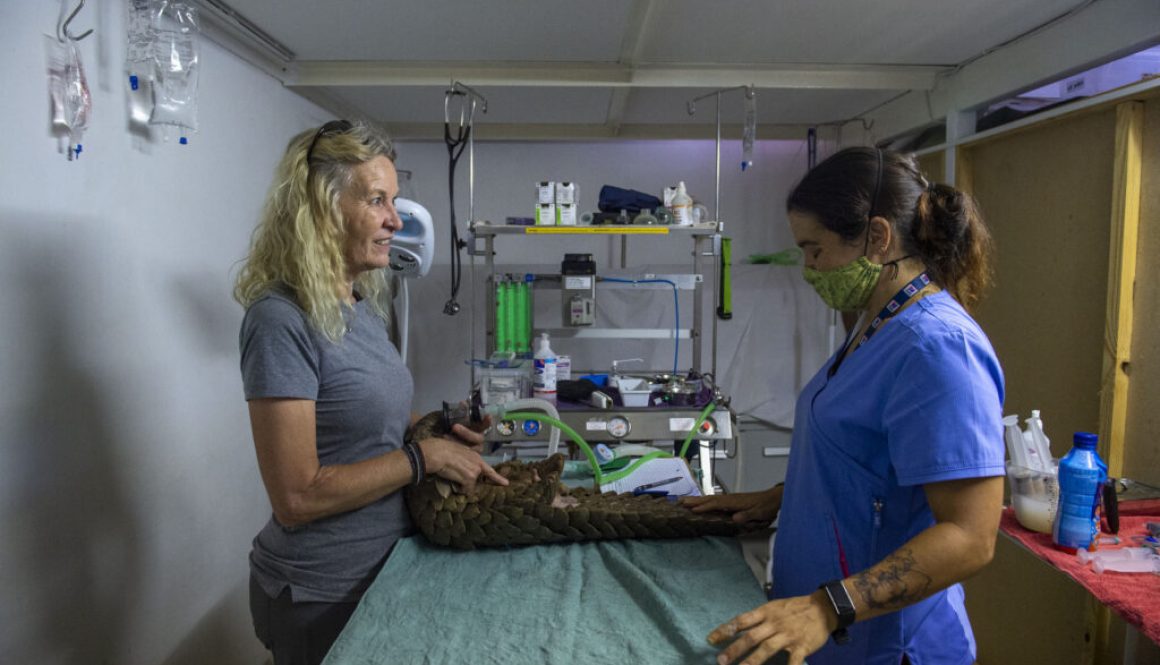
On Thursday 13 May 2021 we took part in a very enjoyable panel discussion hosted by Struik Nature (an imprint of Penguin Books) and Richard Peirce, author of Pangolins: Scales of Injustice
While we did not get to all the questions posed before the event, or all the questions asked by viewers, we did get to chat about our work, the pangolins we work with, and how they are individuals with distinct personalities who display a range of human-comprehensible emotions.
Watch this fascinating talk here:
If you would like to support the work we do for pangolins, please donate through one of our many options.
In addition, if you are in South Africa, please register for a My School card, nominate the African Pangolin Working Group as your beneficiary and swipe it wherever you can.
Join environmental activist, author and broadcaster, Richard Peirce, as he chairs a panel discussion about pangolins and their survival.
Pangolins rescued from traffickers come in all shapes, sizes and states of health.
Do the rehabilitators ever feel like giving up?
How much of their hearts do they give to these animals?
What’s so special about pangolins?
What new and exciting pangolin facts are the scientists uncovering?
Would it matter if the world’s most trafficked mammal became extinct?
Why do humans fall in love with a miniature armoured vehicle with a long tongue?
What does it feel like to sit in a vehicle with a loaded pistol on the seat beside you waiting for a sting operation to go down?
Panelists:
Professor Ray Jansen, founder and chairman of the African Pangolin Working Group, a non-profit organisation dedicated to the conservation of Africa’s four pangolin species.
Dr Karin Lourens, Founder-director and head veterinarian of the Johannesburg Wildlife Veterinary Hospital, passionate about conservation and the foremost expert in the treatment and rehabilitation of Temminck’s pangolin.
Nicci Wright, wildlife rehab specialist with over 20 years of wildlife rehabilitation experience; Executive Director of the African Pangolin Working Group; Wildlife Project Manager of the Humane Society International-Africa and Director of the Johannesburg Wildlife Veterinary Hospital.
Dr Wendy Panaino, nearing completion of her PhD on Temminck’s pangolin in the Kalahari, Wendy is also a project manager on the Kalahari Endangered Ecosystem Project,
Simon Naylor, Conservation Manager for &Beyond Phinda Private Game Reserve. Simon has been involved in pangolin conservation since May 2019.
Introduction and Closing by Mdu Ntuli, a South African interviewer, speaker and podcaster (Mdu’s Mike)
There will be a question and answer session after the discussion. You can send through questions in the Zoom chat function during the talk, or you can send them ahead of time via the email address provided on registration.
On the 5, November 2020, the Mail & Guardian’s environmental reporter Sheree Bega filed the following story about our work.
Nicci Wright gently pushes a syringe filled with warm kitten formula into Tot’s tiny, waiting mouth. The 50-day-old Temminck’s ground pangolin’s thin long tongue slurps it up.
“She loves it and she is really thriving,” says Wright, a wildlife rehabilitation specialist and founder-director of the Johannesburg Wildlife Veterinary Hospital, holding the baby protectively in her arms. “She is so special.”
There are six other poached pangolins — the world’s most trafficked mammal – in the hospital receiving treatment. Like Tot’s mother, Tater, these pangolins rescued from the illicit trade in their body parts spent days or even weeks without food and water before they arrived in the hospital’s healing hands.
“They are highly stressed, malnourished, dehydrated and often injured when they get here.”
Wright struggles to remember each pangolin’s individual case. “We’ve done so many that they are blurring into each other. The trade has definitely increased during the lockdown.”
All eight species of endangered pangolins — four in Africa and four in Asia — are trafficked largely for their scales, used in some traditional Chinese medicines. Pangolin meat, too, is prized as a delicacy in China and Vietnam.
Seized endangered pangolin scales are seen during a press conference at the Kwai Chung Customhouse Cargo Examination Compound in Hong Kong on september 5, 2018. – The Hong Kong Customs and the Agriculture, Fisheries and Conservation Department (AFCD) from June to August 2018 mounted Operation Defender against the smuggling of endangered species at the airport, seaport, land boundary and railway control points into the territory. Some 118 cases were reported during the operation period resulting in the seizure valued at 2.4 million USD, with 82 arrests made. (Photo by ISAAC LAWRENCE / AFP)
The enigmatic, little-known mammals are so threatened that the amount they fetch on the black market cannot be publicised to avert fuelling the trade.
The rescued pangolins are treated at the hospital but kept at a secret location to deter potential poachers.
In July, the police’s stock theft and endangered species unit, working with the African Pangolin Working Group, retrieved Tot’s pregnant mother in a sting operation at a mall in Rustenburg.
She was taken to KwaZulu-Natal in October to begin her soft release programme in the wild, but had complications and is back in the hospital.
“It’s stressful work because they all need treatment, they all need care and need to walk every day and night so we’ve got to find seven extra people to walk them.”
Pangolins don’t eat in captivity and have to be walked for hours to forage on ants and termites as they would naturally.
They are shy, cryptic animals. “It’s been difficult to fight for pangolins or to feel for pangolins because most people don’t know what a pangolin is even though they’ve been around for 84 million years.”
Wildlife vet Dr Karin Lourens, also a founder of the hospital, has become a specialist pangolin vet “because we’ve all been forced to know as much as we can about them,” says Wright.
“Our success rate in treating them is about 80%. We know a lot more about them, it’s still not enough, but it makes us feel more reassured and confident in treating them.”
Lourens says that tackling demand for pangolin body parts is crucial. “I’m optimistic because we are catching more I think, maybe because people are aware, the police are more aware and the judicial system is more aware. Seeing them released is wonderful and most of them that we can follow are doing well. The ones who have died in the field have died of natural cases, by being stomped by an elephant or eaten by a crocodile.”
Tackling South Africa’s illicit trade in pangolins
Not a day goes by that professor Ray Jansen’s phone doesn’t ring — either it’s a pangolin syndicate or a case involving the pangolin trade.
“I put it out there in the bush telegraph. When I hear of a pangolin then I pass my alias on,” says the chairperson of the African Pangolin Working Group.
“I get a WhatsApp that says, ‘Hi sir.’ Then I ask, ‘Can I help you?’ They say, ‘You want a pangolin.’ I tell them I’m interested but this is what I want. That’s how it starts.”
Rescued from illegal traders, the animals are often ill and need treatment before they can be released.
But the poaching syndicates, he says, are on to him. “I’ve changed my alias twice. Last week we lost two cases because my cover was blown, possibly a third. Those pangolins unfortunately probably died in the trade.”
“It tells me that it’s now moved into organised crime and that they are all networking with one another. We’re finding it increasingly difficult to catch them. They’re becoming very shrewd and clued up on how we work.”
Jansen leads a 35-strong unit, which he quips is “probably the largest counter poaching unit for one species”, comprising police stock theft and endangered species units and canine units, the Gauteng Green Scorpions, the US department of homeland security and other covert operatives.
This year, they’ve retrieved 36 animals out of the trade — that was last year’s total. Around 90% of the trade, however, goes undetected — pushing a species already on the brink closer to extinction.
“There’s this perception that these pangolins are worth huge amounts of money. We’re finding huge amounts of illegal contraband. I’ve been offered uncut diamonds and rhino horn twice from the same syndicates trying to sell me pangolins.”
Pangolins at the Johannesburg Wildlife Veterinary Hospital NPC which specialises in the treatment and rehabilitation of indigenous wildlife
The rise in pangolin poaching, he believes, has been spurred by the Covid-19 pandemic. “We’ve seen a surge in opportunistic poaching around southern Africa and South Africa where people have lost their jobs, lost their sources of income, especially in the tourism areas.”
Those smuggling the endangered animals into South Africa are often impoverished and destitute. “They are casualties of this war. The middlemen are organised crime and those are the guys we need to nail. They’re the ones creating the market.”
More and more, there are victories. “We’ve gotten jail sentences of eight years in recent months. These get noticed and serve as a massive deterrent.”
“We’re dealing with a species that are going extinct and we need to fight this on every level, not just on the ground in car parks around Jo’burg and Pretoria, but also in the courts.”
What’s being done
The Chinese government has upgraded the status of pangolins to class 1 — the highest level of protection. Pangolin scales have been removed from the country’s official list of ingredients approved for use in traditional Chinese medicine. But loopholes remain, says Jansen.
Some studies have linked pangolins to the coronavirus infection, but Jansen says it “doesn’t matter what the smoking gun is”.
He agrees with a recommendation from a new major report on pandemics and biodiversity by the Intergovernmental Science-Policy Platform on Biodiversity and Ecosystems (Ipbes) to reduce or remove species in the wildlife trade that are identified as high-risk of disease emergence — like pangolins.
John Scanlon, the former secretary-general of the UN-affiliated Convention on International Trade in Endangered Species (CITES), says that pangolins may be a source of the transmission of the coronavirus. “They were put on CITES Appendix 1 in 2016, often called CITES’ highest level of protection. Yet from 2016-2019, we saw a record 206 tonnes of pangolin scales confiscated. CITES listing did not result in better protection of this extraordinary animal, rather illegal exploitation has surged, and today it’s the world’s most heavily trafficked mammal.”
CITES, he says, is not capable of combating transnational organised crime. “Such capacity lies with police and customs and other enforcement officials and the agencies representing them.”
Scanlon, who is now the chairperson of the Global Initiative to End Wildlife Crime, says the Covid-19 pandemic “reminds us, albeit in a devastating way, of the interconnected nature of things, most particularly between economies, the environment, and human and wildlife health and welfare. This observation applies equally to the wildlife trade – be it legal, illegal, regulated or unregulated.
“This pandemic has reminded us of what the world’s best scientists have been telling us for some time now – wildlife issues are not just about conservation – they are also about public and animal health, and if we get it wrong, it can have massive global implications.”
Wright’s nature is to be optimistic and she clings to that. “These pangolins that come through the hospital are fortunate because they’ve been extricated from this horrific trade. If you consider that last year there were 97 tonnes of African pangolin scales intercepted going into Asia, that’s tens of thousands of animals. They’ve been on the planet for 84 million years and they’re leaving the planet on our watch.”
On the 25th of April 2020, a pangolin was retrieved out of the illegal trade in an intelligence-driven operation by the South African Police Service (SAPS) Endangered Species Unit. Pangolins retrieved from the trade are given names of association with their retrieval location or circumstances, and this one was named Ally. In Ally’s case, her name was derived from her rescue location – the Alldays region of Limpopo Province, South Africa. She was transported by the Limpopo Department of Economic Development Environment and Tourism (LEDET) to Dr Xander de Kock, a veterinary surgeon in Polokwane. Dr de Kock phoned the acknowledged expert in the field of pangolin medicine, Dr Karin Lourens from the Johannesburg Wildlife Veterinary Hospital (JWVH). Dr K immediately left for Polokwane and arrived just before 20:00 on that Saturday evening. She has treated more than 100 Temminck’s pangolin and immediately assisted in stabilizing Ally, who was dehydrated and underweight. During an abdominal ultrasound, Dr de Kock established that Ally was pregnant, which made her treatment and recovery even more urgent. Pregnant pangolins are very rarely seen by researchers and vets, and there are no studies or documentation on the stages of development of pangolin foetuses. Because of this, the doctors had no way to determine the age of the foetus, but they could detect a normal, regular heartbeat. Once Ally was stabilized, Dr K transported her back to a secure location in Johannesburg, arriving in the early hours of Sunday morning. Ally’s road to freedom had begun.
Dr K and Dr Xander examining Ally for the first time
Dr K listening to Ally’s heart and lungs
Hospitalisation, treatment and rehabilitation
Pangolins retrieved out of the illegal wildlife trade are all compromised, with the level of compromise varying between individuals. The trauma is both physical and mental and often complicated by hidden conditions like pneumonia. Ally was no different. Not only was she also suffering from pneumonia, but she had an unborn pup to keep healthy. The news of her pregnancy was both happy and sad for the staff at the hospital as a new life is always wonderful, but the risk of Ally aborting due to stress was great. She was slowly nursed back to health, with regular blood tests, CT scans to make sure her lungs were healing as well as ultrasounds to ensure the pup was developing normally. A few days after her arrival she was stable enough to be taken out to forage – Temminck’s pangolins don’t eat in captivity; they only eat live ants and termites that they find by themselves while taken out on supervised foraging excursions. Ally’s improvement over the first week was marked. She became more confident and finally started behaving like a normal, healthy pangolin. Her lungs had cleared, and she had gained sufficient weight for Dr K to clear her for release.
Ally being prepared for her CT scan. The scan is only a few seconds and does not pose a threat to her unborn pup.
Here Dr K is using a handheld doppler to listen to the foetus’s heartbeat.
Facilitated release back to the wild
Ally was discharged from the JWVH on the 13th of May 2020 and moved up to her selected release site in the Limpopo Valley on the norther border of South Africa with Zimbabwe. Francois Meyer, the African Pangolin Working Group’s Limpopo Field Manager was tasked with managing this delicate release process. All our releases are facilitated processes; designed to slowly introduce retrieved pangolins into their new environments. In Ally’s case it included making certain she had access to sufficient quantities of her desired species of ants and termites and suitable refuge sites. She was fitted with two types of transmitters to ensure efficient post-release monitoring. The first was a VHF transmitter for fine-scaled tracking and the second, a satellite transmitter to locate her should she move out of the 3 km range of the VHF tags. Both tags were attached dorsally to her scales. With these, we will attempt to monitor her well-being for a year or more.
Although it was confirmed that Ally was pregnant during veterinary care, we were still unsure on when exactly she would give birth. One thing was certain though, is that we did not want her to give birth during care or during the release protocol, as this would only place additional stress on her and her unborn pup. The release team made sure to adapt all our protocols to maximize a hands-off approach and to ensure that stress on Ally was kept to a minimum.
Initially her release had us a bit worried, as she was displaying possible stress behaviour and we were worried that she might not adapt and settle down to the selected release site. Our main concern was “fleeing” out of the area, which would be an indication of an extremely stressed animal.
Upon observing her behaviour and taking frequent body weight readings, we actually found the opposite. She was definitely foraging effectively and maintaining a constant body weight. With her movement behaviour however, it was clear that she was looking for more familiar habitat, and this is something we had to take into consideration before her final release.
After careful consideration on our options we decided to take a risk and move her to a slightly different area upon the reserve, and this risk immediately paid off! Ally showed all the signs we were hoping to see in a successful release. She fed on a high diversity of ant species, she gained body weight, she found sufficient shelter and she was showing typical pangolin settling behaviour.
In the following few days, we monitored her behaviour and general signs of health. Once we were satisfied that she was indeed adapting well, we started to reduce our presence within her new territory, only stepping in to collect necessary data for our research.
The success of Ally’s release emphasizes the importance of proficient release teams and that of post-release monitoring.
Born free
Niall Beddy and his team has been monitoring Ally’s movements and checking up on her condition since she was released, and part of this process involves setting camera traps outside of her favourite burrows to record movement and behaviour patterns. We are extremely grateful to the Into the Wilderness Podcast series posted by Byron Pace for the kind donation of these expensive trail cams. We are very aware that continuous disturbances from us could have caused her distress and impacted her pregnancy and motherhood or cause her to leave the region. Camera traps are ideal for monitoring her progress without unnecessary disturbance. It was in one of these recordings that we noticed her new-born pup. This is the first time we have a record of an African pangolin successfully giving birth after being retrieved out of the illegal wildlife trade and being released back into the wild. We are a coalition of proud aunts and uncles, with this first in our history – a new pangolin born free!
Excellent cooperation between the Johannesburg Wildlife Veterinary Hospital, the African Pangolin Working Group, the South African Police Services Endangered Species Unit, the Limpopo Department of Economic Development, Environment and Tourism, the Department of Environmental, Forestry and Fisheries and private game farm owners have made this truly wonderful and amazing event possible and we are sincerely and truly grateful to this fantastic teamwork and rejoice in celebrating the arrival of a new pangolin pup.