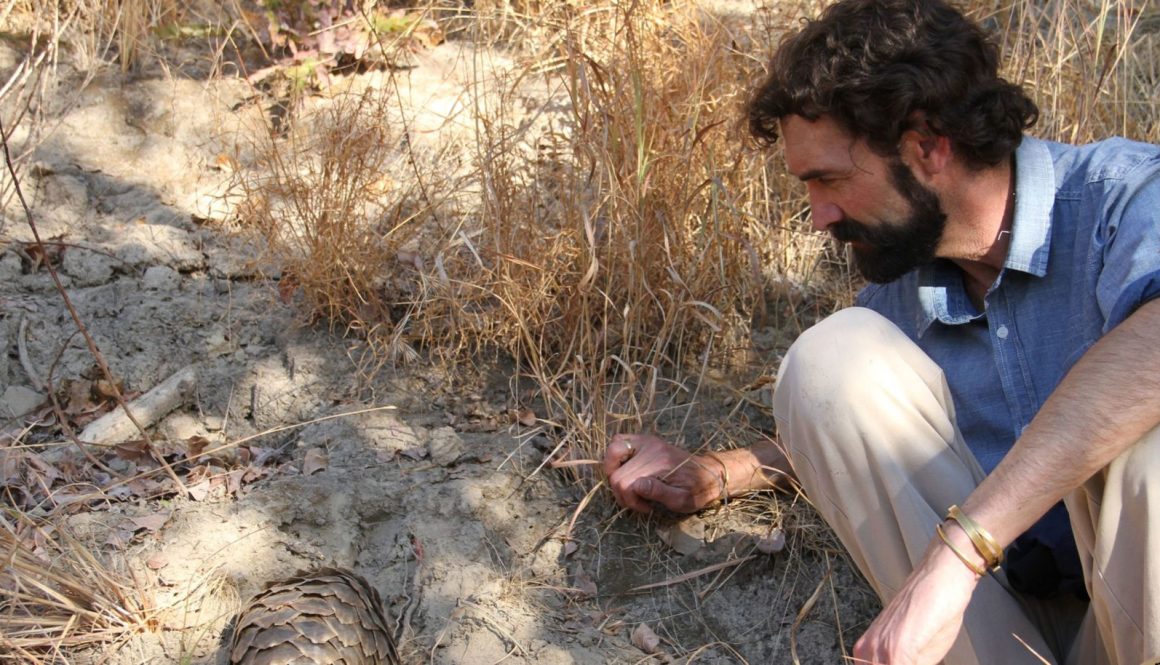
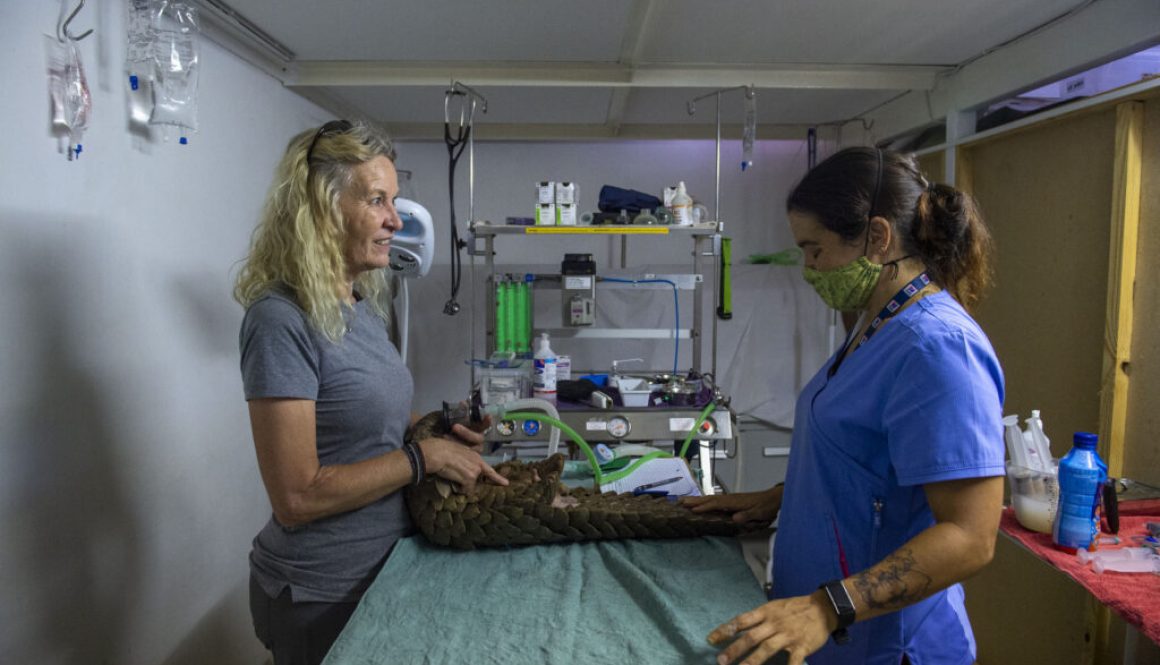
The Democratic Republic of Congo is Africa’s second largest country covering 2 345 million square kilometres. With its tropical rain forests and tropical savannahs, it is considered the most biodiverse country in Africa. While most conservation efforts in the country have been focussed on the endemic great ape species, there is a growing concern for pangolins due to the illegal wildlife trade. The DRC is home to three of the four African pangolin species: giant pangolins, white-bellied pangolins and black-bellied pangolins.
Since its inception, the African Pangolin Working Group has forged relationships with local stakeholders on the ground in several locations across the country, and our rehabilitation experts have advised, supported and funded pangolin rescues. Most of them have been behind the scenes operations, with the occasional rescue story too eventful not to share.
Why travel to the DRC?
When Dr Kelsey Skinner joined the team this year, she arrived fresh from two years working within Vietnam, a global pangolin trade hotspot. Her work focused on capacity building for pangolin rescue and rehabilitation, guiding multiple local and other continental conservation groups on best practice protocols. Imparting her knowledge of the very specific needs of traumatised pangolins and finding practical ways to achieve this goal, left a legacy that will continue to grow.
Recent high numbers of remote rescues have put the team further in touch with conservationists and vets in Kolwezi, Kinshasha, and As a result, Dr Kelsey and co-chair Nicci Wright are planning a two week trip to the DRC to meet up with these contacts and gain a deeper understanding of the conservation challenges they face, and investigate ways to provide support in partnership, working from a well-rounded and effective background of pangolin conservation model knowledge in South Africa and Vietnam
We will report back and let you know how YOU can help with this work in the near future.
“One individual cannot possibly make a difference, alone. It is individual efforts, collectively, that makes a noticeable difference – all the difference in the world!” Jane Goodall
You can make a small difference now
Dr Kelsey has been nominated for the the Worldwide Vets Golden Star Award for 2025. The winner is chosen by public vote which is open from 20 October – 13 November, with the top 10 finalists being announced on November 14.
Dr Kelsey’s unwavering commitment to conserve pangolins continues to inspire us all. Her continued veterinary excellence and compassionate care, for all animals here in South Africa, as well as beyond our borders makes her a worthy recipient that we are proud to have as part of our team.
We are proud to announced the opening of our state-of-the-art pangolin veterinary and rehabilitation facility within the pristine Lapalala Wilderness Reserve, on World Pangolin Day – February 15th, 2025.
APWG co-chair Alexis Kriel addresses the gathered guests
The inauguration event, held over the course of the weekend, marked a significant milestone in the conservation efforts for Temminck’s pangolin, in South Africa, and for the APWG.
Guests entering the Pangolarium for the first time; APWG founder Prof Ray Jansen gets a guided tour from co-chair Nicci Wright; Lunch in the lapa after the opening
Guests included conservationists, representatives from environmental organisations, ecologists, and scientists, all united in their support for the APWG’s ongoing contribution to pangolin conservation in South Africa. Lapalala Wilderness Reserve, spanning approximately 48 000 hectares in Limpopo province, within the UNESCO designated Waterberg Biosphere, offers an ideal environment for pangolin rehabilitation. The reserve’s diverse ecosystems and state-of-the-art security ensure that rehabilitated pangolins have the best chance for a successful reintroduction back into the wild.
The team that made it all happen: Kate Hughes (Lepogo Lodges); Nicci Wright and Alexis Kriel (APWG co-chairs); Glenn Phillips (CEO Lapalala Wilderness); Gareth Thomas (APWG) and Prof Ray Jansen (founder and past chair APWG)
The Pangolarium (meaning a “place for pangolins”) is a purpose-built facility that aims to enhance the rescue, veterinary high care, rehabilitation, and reintroduction processes for pangolins rescued from the illegal wildlife trade on the west side of Limpopo Province, also accessible from the north of the province, and with a doorway into North West Province. Equipped with advanced medical and husbandry resources, the centre provides a facility where this vulnerable species can recover and prepare for a return to their natural habitat. It will also serve as a basecamp for the APWG’s ongoing research and education initiatives.
The building of the facility has been financed by Lepogo Lodges – an NGO Lodge operator on Lapalala Wilderness Reserve and the Sustainability winner of the Ahead Travel Awards, for Melote House, in the MEA division.
Limpopo Province is historically the province with the highest incidence of pangolins retrieved from the illegal trade, sharing borders with Zimbabwe, Mozambique, and Botswana – all pangolin range countries – where transboundary collaborators facilitate the poaching and sale of pangolins in South Africa. Pangolins are currently considered the most illegally trade non-human mammal on the planet, with the eight species (four in Africa and four in Asia) varying from vulnerable to endangered on the IUCN Red List, and with all populations decreasing. They have been resident on earth for 85 million years.
The APWG invites the global community to join in supporting our pangolin conservation efforts. For more information on how to contribute or get involved, please visit our donations page.
Our Together for Pangolins evening at CIRCA Gallery in Rosebank was a raging success.
The evening started on the upper deck and Darwin Room of the Circa Gallery with glasses of wine from Painted Wolf Wine and Waterford Estate, Vergelegen sparkling wine and a delicious harvest table from Service Station Cafe. A spectacular view of the sunset over Johannesburg, a fire pit and fantastic company set the mood for the evening.
Harvest table spread from Service Station Cafe in Melville
At 6:30pm the guest went down to the Middle Gallery to view the wonderful art and enjoy a video of pangolin photos put together by John Culverwell of Adlip video services.
Christine Read opened the event, followed by co-chair, Nicci Wright, who gave an informative talk about the essential work being done by the African Pangolin Working Group.
APWG co-chair Nicci Wright
After this opening, multi-award winning writer/director of My Octopus Teacher, Pippa Ehrlich, kept the gathering captivated with a talk about her next Netflix documentary, which centres around a special relationship with a pangolin and his minder.
Pippa Ehrlich with part of her rapt audience
Susie Goodman of Strauss & Co was a fantastic auctioneer of the curated art and luxury items in our live auction. Our guest enjoyed some lively bidding using the pangolin shaped paddles especially made for us by the Aluminum Trading Group. After the auction, our guest enjoyed more food and wine.
The full thank you list
Mark and Christine Read and their brilliant team at Everard Read Galleries for their generosity and support.
Carolynne Waterhouse of Rand Merchant Bank for her guidance and indefatigable energy and enthusiasm for pangolins.
Susie Goodman, Jackie Murray, Keanu Crause and the rest of the Strauss & Co team for their incredible generosity and support of the online and live auctions. Especially Susie for her auctioneering talents at the live auction.
Guy du Toit for being inspired enough to make three enchanting bronzes of hares with pangolins especially for this event.
Monique Landman (Everard Read) for hanging the artworks so expertly in the CIRCA Gallery.
Jillian Johnson (Everard Read) whose smile lit up every conversation and was our point of contact in the management of the event.
Magnificent Pippa Erhlich for her enthralling talk and for the fascinating peek into the world of award-winning wildlife filmmaking.
Angus and Piet from African Massive
Angus Morton and Piet Modiba from Africa Massive for once again providing stellar audio-visual services.
Carmen vd Merwe from Service Station Café for the out-of-this-world delicious food.
Painted Wolf Wines for their wine and their constant support of conservation and endangered species.
John Culverwell of Adlip video services for his beautiful videos and for technical support.
Douw van Heerden for being our artist in residence and creating under the spotlight on the night.
Peter Girdwood – making gorgeous frames from Kajima’s travelling box for Gareth’s photos of Kajima.
Rowena Allan for the luxurious picnic baskets.
Amy Irving and Demz Viljoen-Doyle for their huge help on the night.
Stunning auction paddles in the shape of pangolins donated by Christopher and Andy of Aluminium Trading Group.
All the artists, artisans and donors, who so generously supported us with artwork and who turned up to support us on the evening.
All the people who bought tickets to the event and bid so enthusiastically in the auction.
Clockwise from left: Comma by Steven John Wilkins, Smutsia Temminckii – Temminck Ground Pangolin by Gillian Condy, Tshukudu Njana, Uyema (Maquette) by Angus Taylor, Seated Hare with Pangolin by Guy du Toit
Clockwise from top left: Singularity by Gareth Thomas, So Below by Gareth Thomas, Pangolin Boy by Robert Rorich
Clockwise from left: Balancing Act by John Moore, We are all in this Together by John Moore, Icon series: Pangolin by John Moore, Freedom Feels by Gareth Thomas
The following pieces were full donations by these outstandingly generous people:
Robert Rorich who donated his bronze sculpture Pangolin Boy.
Carolynne Waterhouse for the donations of the Noush Doll, Addo Flightless Dung Beetle, and Lion Paw, both by Robert Leggat.
Gareth Thomas for his donation of three photographic images and Kajima’s transport box that was used for the frames.
Gareth Thomas, photographer, talking about his special relationship with the pangolin, Kajima, who was featured in three photographs donated to the fund raiser.
Gillian Condy for her original Temminck’s pangolin water colour.
Carol Slabolepszy for her acrylic-resin Mother and Pup sculpture in silver-grey pewter finish.
Jez Prettejohn of African Pewter for the pangolin salad servers.
With the generosity of our donors and supporters we raised good funding for our work, but more than that, pangolins were very beautifully showcased, magnifying their extraordinary and unique charm. You couldn’t help but fall in love with them.
TOGETHER FOR PANGOLINS, on July 25th, is a collaboration between Everard Read Gallery, Stauss & Co Art Auctioneers, and the African Pangolin Working Group. The aim is to raise awareness and funds for the continued work of saving pangolins now and in the future. Everard Read has donated its CIRCA Art Gallery for this event – an architectural landmark, on the Keyes Art Mile. CIRCA winds its way up three stories in a Fibonacci spiral – a golden ratio found all throughout nature, and significantly in the coil of a pangolin.
The speaker at the event is Pippa Ehrlich – the multi-award winning co-writer and director of the Netflix documentary “My Octopus Teacher”. Pippa will talk about her next film, which explores the intimate relationship between a pangolin named Kajima and his minder Gareth Thomas, while Kajima was being rehabilitated and then released back into a protected wildlife reserve. Gareth Thomas will also be at CIRCA event, and his photograph of Kajima – framed in the wood of Kajima’s sleeping box, will be on auction.
Pangolin Candle Holders by Ardmore Design, Donated by Charles Grieg Jewellers
Balancing Act by John Moore. An edition is also available in the online auction.
Freedom Feels by Gareth Thomas
Hare with Pangolin by Guy du Toit
Hare with Pangolin by Guy du Toit
Icon Series – Pangolin by John Moore. An edition is also available in the online auction
Girl with Pangoln Noush Doll. Donated by Caroline Waterhouse
Bronze Pangolin by Robert Leggat
Pangolin and pup by Carol Slabolepsky
Pewter Pangolin Salad Servers by African Pewter.
Pewter Pangolins by African Pewter.
Two night stay for two at andBeyond Phinda Mountain or Forest Lodge. Donated by andBeyond
Dung beetle sculpture by Robert Leggat.
Pangolin Cuff by Susan von Zahn
Two night stay for two at Umlani Bush Camp. Donate by Umlani
For the event at CIRCA Art Gallery, a curated collection of mainly pangolin-themed artworks and sculptures, will be auctioned, by the dynamic Executive Director of Strauss & Co, Susie Goodman.
Online Auction at Strauss & Co
Also for pangolin conservation, and running concurrently with the July 25th event at CIRCA; Strauss & Co will have an exhibition of works for viewing at their gallery, in Houghton, Johannesburg, which will be auctioned from their online platform, between July 24th and August 5th – accessed through the Strauss & Co website. The works are all by upcoming and established artists and sculptors, who have aligned themselves with this important conservation cause.
Comma by Steven John Wilkins
The Bringer of Rain by Douw van Heerden
Together into the Light by Douw van Heerden
Singularity by Gareth Thomas
SoBelow by Gareth Thomas
Gender Responsibility by Wayne Barker
Pangolin by Gerbrand van Heerden
Untitled (Pangolin) by Gerbrand van Heerden
Smutsia Temminckii – Temminck Ground Pangolin by Gillian Condy
Red Earth Pangolin by Lin Barrie
Deft Series – Pangolin by John Moore
Pangolin Boy by Robert Rorich
Regeneration by Marilyn MacDowell
Seated Hare with Pangolin by Guy du Toit
Trashed by Wayne Barker
Tshukudu Njana, Uyema (Maquette) by Angus Taylor
We Are All in This Together by John Moore
The artist, speaker and donors of these events have been incredibly generous and all have an intense love of endangered species and the environment in which they live. We would like to thank them all!
Other donors include Painted Wolf Wines, Rand Merchant Bank, Africa Massive, Umlani Bushcamp, andBeyond Phinda Private Game Reserve, Vergelegen Wine Estate, Adlip Video, Reciprocal Wine Company, Charles Greig Jewellers, African Pewter, Carolynne Waterhouse and Mark-it Wise.
We value your contribution to our mission to save the most trafficked mammal!
With your help, we have had our best year so far and we have new and exciting plans for the future of our organisation.
You will find our Chairman’s report here. We pride ourselves on transparency, ethics, good governance, kindness to animals and harmony between us humans.
Ray Jansen
Our mentor and friend, Prof Ray Jansen has resigned as the Chairman of the APWG after 12 years at the helm of what has become a remarkable organisation – it started off as a conversation between likeminded individuals in 2009, the organisation was established as an NPO in 2011 and today we have an international reputation and successes that we would not have imagined would be possible.
Ray has been granted Honorary Life Membership with the APWG, so while he steps down from his immediate role as the chairman of our group, he will not be going away anytime soon.
In Rays words:
After 12 years of working with pangolins and 10 years following the establishment of the African Pangolin Working Group (APWG), I have decided to resign as Chairman and Board member and revert back to my focus on academia – my teaching, but more importantly scientific research in the natural world. I have been truly blessed to be a part of such a wonderful, vibrant and active pangolin conservation organisation that is the APWG and, to have support from such an amazing collective of individuals that make up its Board and field staff. More than that, how can one describe the privilege it has been to work with pangolins. They are spiritual, bewitching, mystical and peaceful beings that have taught me much about life and about the joys and horror that is human nature. I have been honoured by the APWG Board with a Life Membership, for which I am truly humbled. As such, I remain part of this incredible organisation and will continue to assist and support where I can. Nicci Wright and Alexis Kriel have been voted collective co-chairpersons of the organisation – I cannot think of two better people to take the APWG through to greater heights as the organisation currently experiences a growth phase. I remain active and committed to my pangolin research with my postgraduate students and hope to continue for many years to come.
Our work
Our work spans the fields of intelligence operations, confiscations of pangolins from the illegal trade and we are mandated by the South African Government to oversee the high care, rehabilitation of pangolins and their release back into an appropriate wildlife area. We do training for law enforcement, prosecutors, vets and rehabilitation specialists in South Africa and beyond, we work closely with SAPS and the Environmental Inspectorate and our publication of research is extensive.
The African Pangolin Working Group is currently in a growth phase where we are formalising our structure and moving towards an increase in staff. In the last 10 days, we entered into a grant agreement with USAID for combatting pangolin-related wildlife crime in the Great Limpopo Transfrontier Conservation area which spans the borders of South Africa, Mozambique and Zimbabwe. We are in the process of purchasing a vehicle with sponsorship provided by Pangolin Crisis Fund and invitations for projects with artists, photographers and the media come in on a daily basis. Our second International Pangolin Conference will be held in Kruger Park in September and virtually at the same time, with pangolin conservation specialists presenting from across the globe.
We feel excited about the next phase in the life of our organisation. We will continue to grow, to meet the challenges of saving a creature that belongs on this planet and we welcome you to continue to partner with us going forwards.
On Thursday 13 May 2021 we took part in a very enjoyable panel discussion hosted by Struik Nature (an imprint of Penguin Books) and Richard Peirce, author of Pangolins: Scales of Injustice
While we did not get to all the questions posed before the event, or all the questions asked by viewers, we did get to chat about our work, the pangolins we work with, and how they are individuals with distinct personalities who display a range of human-comprehensible emotions.
Watch this fascinating talk here:
If you would like to support the work we do for pangolins, please donate through one of our many options.
In addition, if you are in South Africa, please register for a My School card, nominate the African Pangolin Working Group as your beneficiary and swipe it wherever you can.
Join environmental activist, author and broadcaster, Richard Peirce, as he chairs a panel discussion about pangolins and their survival.
Pangolins rescued from traffickers come in all shapes, sizes and states of health.
Do the rehabilitators ever feel like giving up?
How much of their hearts do they give to these animals?
What’s so special about pangolins?
What new and exciting pangolin facts are the scientists uncovering?
Would it matter if the world’s most trafficked mammal became extinct?
Why do humans fall in love with a miniature armoured vehicle with a long tongue?
What does it feel like to sit in a vehicle with a loaded pistol on the seat beside you waiting for a sting operation to go down?
Panelists:
Professor Ray Jansen, founder and chairman of the African Pangolin Working Group, a non-profit organisation dedicated to the conservation of Africa’s four pangolin species.
Dr Karin Lourens, Founder-director and head veterinarian of the Johannesburg Wildlife Veterinary Hospital, passionate about conservation and the foremost expert in the treatment and rehabilitation of Temminck’s pangolin.
Nicci Wright, wildlife rehab specialist with over 20 years of wildlife rehabilitation experience; Executive Director of the African Pangolin Working Group; Wildlife Project Manager of the Humane Society International-Africa and Director of the Johannesburg Wildlife Veterinary Hospital.
Dr Wendy Panaino, nearing completion of her PhD on Temminck’s pangolin in the Kalahari, Wendy is also a project manager on the Kalahari Endangered Ecosystem Project,
Simon Naylor, Conservation Manager for &Beyond Phinda Private Game Reserve. Simon has been involved in pangolin conservation since May 2019.
Introduction and Closing by Mdu Ntuli, a South African interviewer, speaker and podcaster (Mdu’s Mike)
There will be a question and answer session after the discussion. You can send through questions in the Zoom chat function during the talk, or you can send them ahead of time via the email address provided on registration.
On the 5, November 2020, the Mail & Guardian’s environmental reporter Sheree Bega filed the following story about our work.
Nicci Wright gently pushes a syringe filled with warm kitten formula into Tot’s tiny, waiting mouth. The 50-day-old Temminck’s ground pangolin’s thin long tongue slurps it up.
“She loves it and she is really thriving,” says Wright, a wildlife rehabilitation specialist and founder-director of the Johannesburg Wildlife Veterinary Hospital, holding the baby protectively in her arms. “She is so special.”
There are six other poached pangolins — the world’s most trafficked mammal – in the hospital receiving treatment. Like Tot’s mother, Tater, these pangolins rescued from the illicit trade in their body parts spent days or even weeks without food and water before they arrived in the hospital’s healing hands.
“They are highly stressed, malnourished, dehydrated and often injured when they get here.”
Wright struggles to remember each pangolin’s individual case. “We’ve done so many that they are blurring into each other. The trade has definitely increased during the lockdown.”
All eight species of endangered pangolins — four in Africa and four in Asia — are trafficked largely for their scales, used in some traditional Chinese medicines. Pangolin meat, too, is prized as a delicacy in China and Vietnam.
Seized endangered pangolin scales are seen during a press conference at the Kwai Chung Customhouse Cargo Examination Compound in Hong Kong on september 5, 2018. – The Hong Kong Customs and the Agriculture, Fisheries and Conservation Department (AFCD) from June to August 2018 mounted Operation Defender against the smuggling of endangered species at the airport, seaport, land boundary and railway control points into the territory. Some 118 cases were reported during the operation period resulting in the seizure valued at 2.4 million USD, with 82 arrests made. (Photo by ISAAC LAWRENCE / AFP)
The enigmatic, little-known mammals are so threatened that the amount they fetch on the black market cannot be publicised to avert fuelling the trade.
The rescued pangolins are treated at the hospital but kept at a secret location to deter potential poachers.
In July, the police’s stock theft and endangered species unit, working with the African Pangolin Working Group, retrieved Tot’s pregnant mother in a sting operation at a mall in Rustenburg.
She was taken to KwaZulu-Natal in October to begin her soft release programme in the wild, but had complications and is back in the hospital.
“It’s stressful work because they all need treatment, they all need care and need to walk every day and night so we’ve got to find seven extra people to walk them.”
Pangolins don’t eat in captivity and have to be walked for hours to forage on ants and termites as they would naturally.
They are shy, cryptic animals. “It’s been difficult to fight for pangolins or to feel for pangolins because most people don’t know what a pangolin is even though they’ve been around for 84 million years.”
Wildlife vet Dr Karin Lourens, also a founder of the hospital, has become a specialist pangolin vet “because we’ve all been forced to know as much as we can about them,” says Wright.
“Our success rate in treating them is about 80%. We know a lot more about them, it’s still not enough, but it makes us feel more reassured and confident in treating them.”
Lourens says that tackling demand for pangolin body parts is crucial. “I’m optimistic because we are catching more I think, maybe because people are aware, the police are more aware and the judicial system is more aware. Seeing them released is wonderful and most of them that we can follow are doing well. The ones who have died in the field have died of natural cases, by being stomped by an elephant or eaten by a crocodile.”
Tackling South Africa’s illicit trade in pangolins
Not a day goes by that professor Ray Jansen’s phone doesn’t ring — either it’s a pangolin syndicate or a case involving the pangolin trade.
“I put it out there in the bush telegraph. When I hear of a pangolin then I pass my alias on,” says the chairperson of the African Pangolin Working Group.
“I get a WhatsApp that says, ‘Hi sir.’ Then I ask, ‘Can I help you?’ They say, ‘You want a pangolin.’ I tell them I’m interested but this is what I want. That’s how it starts.”
Rescued from illegal traders, the animals are often ill and need treatment before they can be released.
But the poaching syndicates, he says, are on to him. “I’ve changed my alias twice. Last week we lost two cases because my cover was blown, possibly a third. Those pangolins unfortunately probably died in the trade.”
“It tells me that it’s now moved into organised crime and that they are all networking with one another. We’re finding it increasingly difficult to catch them. They’re becoming very shrewd and clued up on how we work.”
Jansen leads a 35-strong unit, which he quips is “probably the largest counter poaching unit for one species”, comprising police stock theft and endangered species units and canine units, the Gauteng Green Scorpions, the US department of homeland security and other covert operatives.
This year, they’ve retrieved 36 animals out of the trade — that was last year’s total. Around 90% of the trade, however, goes undetected — pushing a species already on the brink closer to extinction.
“There’s this perception that these pangolins are worth huge amounts of money. We’re finding huge amounts of illegal contraband. I’ve been offered uncut diamonds and rhino horn twice from the same syndicates trying to sell me pangolins.”
Pangolins at the Johannesburg Wildlife Veterinary Hospital NPC which specialises in the treatment and rehabilitation of indigenous wildlife
The rise in pangolin poaching, he believes, has been spurred by the Covid-19 pandemic. “We’ve seen a surge in opportunistic poaching around southern Africa and South Africa where people have lost their jobs, lost their sources of income, especially in the tourism areas.”
Those smuggling the endangered animals into South Africa are often impoverished and destitute. “They are casualties of this war. The middlemen are organised crime and those are the guys we need to nail. They’re the ones creating the market.”
More and more, there are victories. “We’ve gotten jail sentences of eight years in recent months. These get noticed and serve as a massive deterrent.”
“We’re dealing with a species that are going extinct and we need to fight this on every level, not just on the ground in car parks around Jo’burg and Pretoria, but also in the courts.”
What’s being done
The Chinese government has upgraded the status of pangolins to class 1 — the highest level of protection. Pangolin scales have been removed from the country’s official list of ingredients approved for use in traditional Chinese medicine. But loopholes remain, says Jansen.
Some studies have linked pangolins to the coronavirus infection, but Jansen says it “doesn’t matter what the smoking gun is”.
He agrees with a recommendation from a new major report on pandemics and biodiversity by the Intergovernmental Science-Policy Platform on Biodiversity and Ecosystems (Ipbes) to reduce or remove species in the wildlife trade that are identified as high-risk of disease emergence — like pangolins.
John Scanlon, the former secretary-general of the UN-affiliated Convention on International Trade in Endangered Species (CITES), says that pangolins may be a source of the transmission of the coronavirus. “They were put on CITES Appendix 1 in 2016, often called CITES’ highest level of protection. Yet from 2016-2019, we saw a record 206 tonnes of pangolin scales confiscated. CITES listing did not result in better protection of this extraordinary animal, rather illegal exploitation has surged, and today it’s the world’s most heavily trafficked mammal.”
CITES, he says, is not capable of combating transnational organised crime. “Such capacity lies with police and customs and other enforcement officials and the agencies representing them.”
Scanlon, who is now the chairperson of the Global Initiative to End Wildlife Crime, says the Covid-19 pandemic “reminds us, albeit in a devastating way, of the interconnected nature of things, most particularly between economies, the environment, and human and wildlife health and welfare. This observation applies equally to the wildlife trade – be it legal, illegal, regulated or unregulated.
“This pandemic has reminded us of what the world’s best scientists have been telling us for some time now – wildlife issues are not just about conservation – they are also about public and animal health, and if we get it wrong, it can have massive global implications.”
Wright’s nature is to be optimistic and she clings to that. “These pangolins that come through the hospital are fortunate because they’ve been extricated from this horrific trade. If you consider that last year there were 97 tonnes of African pangolin scales intercepted going into Asia, that’s tens of thousands of animals. They’ve been on the planet for 84 million years and they’re leaving the planet on our watch.”
Dazzile Africa recently screened Eye of the Pangolin film on their website.
Afterwards, APWG’s Nicci Wright took part in a panel discussion with filmmaker Bruce Young, Paul Thomson of Save Pangolins, Rod Cassidy from Sangha Lodge, and Kate Wilson from Mulberry Mongoose.
Amongst other things they discussed the magic of looking a pangolin in the eye, the propulsion of pangolins into the spotlight because of covid-19, and other coronavirus related facts about pangolins.
They also discussed the importance of getting the younger generation to advocate for Pangolins – including a picture book suggestion.
There were quite a few questions asked that the panelist could not answer because pangolins are so elusive – how long do they live if not interferred with by people?, which country has the largest population of pangolins?, and do pangolins have twins?
It is a fascinating film and an interesting discussion – spend a few lockdown hours learning all about pangolins!
To watch the entire film and discussion click here