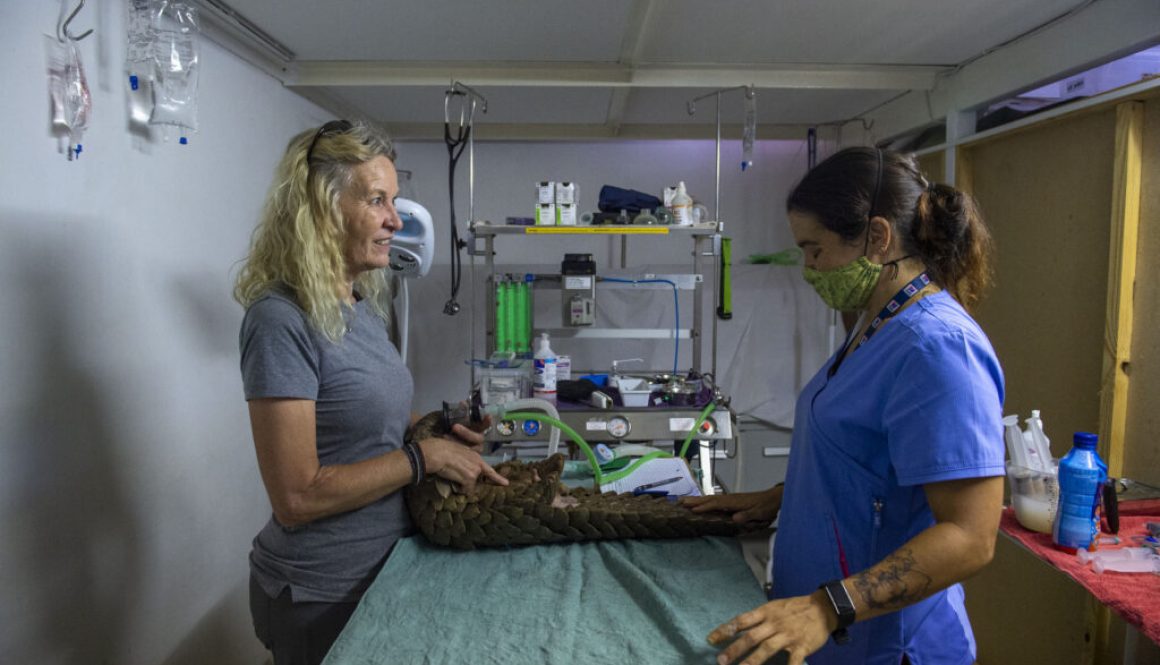
We are proud to announced the opening of our state-of-the-art pangolin veterinary and rehabilitation facility within the pristine Lapalala Wilderness Reserve, on World Pangolin Day – February 15th, 2025.
APWG co-chair Alexis Kriel addresses the gathered guests
The inauguration event, held over the course of the weekend, marked a significant milestone in the conservation efforts for Temminck’s pangolin, in South Africa, and for the APWG.
Guests entering the Pangolarium for the first time; APWG founder Prof Ray Jansen gets a guided tour from co-chair Nicci Wright; Lunch in the lapa after the opening
Guests included conservationists, representatives from environmental organisations, ecologists, and scientists, all united in their support for the APWG’s ongoing contribution to pangolin conservation in South Africa. Lapalala Wilderness Reserve, spanning approximately 48 000 hectares in Limpopo province, within the UNESCO designated Waterberg Biosphere, offers an ideal environment for pangolin rehabilitation. The reserve’s diverse ecosystems and state-of-the-art security ensure that rehabilitated pangolins have the best chance for a successful reintroduction back into the wild.
The team that made it all happen: Kate Hughes (Lepogo Lodges); Nicci Wright and Alexis Kriel (APWG co-chairs); Glenn Phillips (CEO Lapalala Wilderness); Gareth Thomas (APWG) and Prof Ray Jansen (founder and past chair APWG)
The Pangolarium (meaning a “place for pangolins”) is a purpose-built facility that aims to enhance the rescue, veterinary high care, rehabilitation, and reintroduction processes for pangolins rescued from the illegal wildlife trade on the west side of Limpopo Province, also accessible from the north of the province, and with a doorway into North West Province. Equipped with advanced medical and husbandry resources, the centre provides a facility where this vulnerable species can recover and prepare for a return to their natural habitat. It will also serve as a basecamp for the APWG’s ongoing research and education initiatives.
The building of the facility has been financed by Lepogo Lodges – an NGO Lodge operator on Lapalala Wilderness Reserve and the Sustainability winner of the Ahead Travel Awards, for Melote House, in the MEA division.
Limpopo Province is historically the province with the highest incidence of pangolins retrieved from the illegal trade, sharing borders with Zimbabwe, Mozambique, and Botswana – all pangolin range countries – where transboundary collaborators facilitate the poaching and sale of pangolins in South Africa. Pangolins are currently considered the most illegally trade non-human mammal on the planet, with the eight species (four in Africa and four in Asia) varying from vulnerable to endangered on the IUCN Red List, and with all populations decreasing. They have been resident on earth for 85 million years.
The APWG invites the global community to join in supporting our pangolin conservation efforts. For more information on how to contribute or get involved, please visit our donations page.
TOGETHER FOR PANGOLINS, on July 25th, is a collaboration between Everard Read Gallery, Stauss & Co Art Auctioneers, and the African Pangolin Working Group. The aim is to raise awareness and funds for the continued work of saving pangolins now and in the future. Everard Read has donated its CIRCA Art Gallery for this event – an architectural landmark, on the Keyes Art Mile. CIRCA winds its way up three stories in a Fibonacci spiral – a golden ratio found all throughout nature, and significantly in the coil of a pangolin.
The speaker at the event is Pippa Ehrlich – the multi-award winning co-writer and director of the Netflix documentary “My Octopus Teacher”. Pippa will talk about her next film, which explores the intimate relationship between a pangolin named Kajima and his minder Gareth Thomas, while Kajima was being rehabilitated and then released back into a protected wildlife reserve. Gareth Thomas will also be at CIRCA event, and his photograph of Kajima – framed in the wood of Kajima’s sleeping box, will be on auction.
Pangolin Candle Holders by Ardmore Design, Donated by Charles Grieg Jewellers
Balancing Act by John Moore. An edition is also available in the online auction.
Freedom Feels by Gareth Thomas
Hare with Pangolin by Guy du Toit
Hare with Pangolin by Guy du Toit
Icon Series – Pangolin by John Moore. An edition is also available in the online auction
Girl with Pangoln Noush Doll. Donated by Caroline Waterhouse
Bronze Pangolin by Robert Leggat
Pangolin and pup by Carol Slabolepsky
Pewter Pangolin Salad Servers by African Pewter.
Pewter Pangolins by African Pewter.
Two night stay for two at andBeyond Phinda Mountain or Forest Lodge. Donated by andBeyond
Dung beetle sculpture by Robert Leggat.
Pangolin Cuff by Susan von Zahn
Two night stay for two at Umlani Bush Camp. Donate by Umlani
For the event at CIRCA Art Gallery, a curated collection of mainly pangolin-themed artworks and sculptures, will be auctioned, by the dynamic Executive Director of Strauss & Co, Susie Goodman.
Online Auction at Strauss & Co
Also for pangolin conservation, and running concurrently with the July 25th event at CIRCA; Strauss & Co will have an exhibition of works for viewing at their gallery, in Houghton, Johannesburg, which will be auctioned from their online platform, between July 24th and August 5th – accessed through the Strauss & Co website. The works are all by upcoming and established artists and sculptors, who have aligned themselves with this important conservation cause.
Comma by Steven John Wilkins
The Bringer of Rain by Douw van Heerden
Together into the Light by Douw van Heerden
Singularity by Gareth Thomas
SoBelow by Gareth Thomas
Gender Responsibility by Wayne Barker
Pangolin by Gerbrand van Heerden
Untitled (Pangolin) by Gerbrand van Heerden
Smutsia Temminckii – Temminck Ground Pangolin by Gillian Condy
Red Earth Pangolin by Lin Barrie
Deft Series – Pangolin by John Moore
Pangolin Boy by Robert Rorich
Regeneration by Marilyn MacDowell
Seated Hare with Pangolin by Guy du Toit
Trashed by Wayne Barker
Tshukudu Njana, Uyema (Maquette) by Angus Taylor
We Are All in This Together by John Moore
The artist, speaker and donors of these events have been incredibly generous and all have an intense love of endangered species and the environment in which they live. We would like to thank them all!
Other donors include Painted Wolf Wines, Rand Merchant Bank, Africa Massive, Umlani Bushcamp, andBeyond Phinda Private Game Reserve, Vergelegen Wine Estate, Adlip Video, Reciprocal Wine Company, Charles Greig Jewellers, African Pewter, Carolynne Waterhouse and Mark-it Wise.
While the world has been focussing on CoP 27 United Nations Climate Conference in Sharm el-Sheikh, Egypt, there is another, related and equally important CoP meeting happening in Panama for the next 10 days – the CITES CoP Conference.
‘CoP’ meeting is the most important meeting in the context of CITES, as Parties take on a significant body of tasks, including the following:
Reviewing progress in the conservation of species included in the Appendices;
Debating proposals to amend the lists of species in Appendices I and II;
Discussing documents and reports from Parties, the Standing Committee, the Animals Committee, the Plants Committee, or the Secretariat;
Recommending measures to improve the effectiveness of the Convention, including the drafting and adoption of Resolutions and Decisions to be implemented by all Parties, the Standing Committee, the Scientific Committees and the Secretariat;
Meetings of the Conference of the Parties are attended not only by CITES Parties but also by observers, including representatives of multilateral and non-governmental organizations involved in conservation or trade.
‘CoP 19’ will mark the 19th time that Parties have gathered since the Convention entered into force in 1975.
Some items of interest
Thursday 17th November:
Scaling up efforts to address pangolin trafficking in Africa
A side event with delegates from Gabon, Government of Kenya, Nigeria Customs, Fauna & Flora International and the IUCN SSC Pangolin SG
Tuesday 15th November:
Coopération internationale pour l’analyse des grandes saisies d’ivoire et de pangolins – l’expérience du laboratoire de génétique du Gabon [International cooperation for the analysis of large seizures of ivory and pangolins – the experience of the genetics laboratory of Gabon]
A side event held by the Goverment of Gabon
Monday 21st November:
Participation of Local Communities in the Management of Protected Areas and Biodiversity Economy: A South Africa’s People and Parks, Wildlife and Bioprospecting Economy Programmes Implementation
A side event hosted by the South African Department of Forestry Fisheries and the Environment
Tuesday 22 November:
Creating a coordinated approach to combat wildlife crime linked to the internet
A side event hosted by Costa Rica and IFAW
There are many interesting subjects under discussion. To see the entire list, click here
To live stream the sessions of this conference, click here.
Committee 2 deals with implementation matters, including species-specific matters. From Tuesday 15th onwards, you can livestream either Committee 1 or Committee 2.Live streaming starts at around 14h00 in South Africa (Panama is several hours behind us)
Wildlife trafficking on the internet
There are a few items on the agenda focusing on combating the role played by the internet in connecting traffickers to potential clients. To illustrate this very serious point, here is an article that appeared in the South China Morning Post today. It exposes some of the social media channels used to sell animals and their parts
On a ‘Buy and Sell Wildlife’ Facebook page, a broker proudly shows off photos featuring kilos of two-inch scales from the pangolin – a mammal whose skin and scales have made it one of the world’s most trafficked creatures.
We hope you can attend some of these discussion, albeit virtually, and if you feel strongly about the issues on hand, take action by supporting local conservation efforts to stop the illegal trade in wildlife.
On the 5, November 2020, the Mail & Guardian’s environmental reporter Sheree Bega filed the following story about our work.
Nicci Wright gently pushes a syringe filled with warm kitten formula into Tot’s tiny, waiting mouth. The 50-day-old Temminck’s ground pangolin’s thin long tongue slurps it up.
“She loves it and she is really thriving,” says Wright, a wildlife rehabilitation specialist and founder-director of the Johannesburg Wildlife Veterinary Hospital, holding the baby protectively in her arms. “She is so special.”
There are six other poached pangolins — the world’s most trafficked mammal – in the hospital receiving treatment. Like Tot’s mother, Tater, these pangolins rescued from the illicit trade in their body parts spent days or even weeks without food and water before they arrived in the hospital’s healing hands.
“They are highly stressed, malnourished, dehydrated and often injured when they get here.”
Wright struggles to remember each pangolin’s individual case. “We’ve done so many that they are blurring into each other. The trade has definitely increased during the lockdown.”
All eight species of endangered pangolins — four in Africa and four in Asia — are trafficked largely for their scales, used in some traditional Chinese medicines. Pangolin meat, too, is prized as a delicacy in China and Vietnam.
Seized endangered pangolin scales are seen during a press conference at the Kwai Chung Customhouse Cargo Examination Compound in Hong Kong on september 5, 2018. – The Hong Kong Customs and the Agriculture, Fisheries and Conservation Department (AFCD) from June to August 2018 mounted Operation Defender against the smuggling of endangered species at the airport, seaport, land boundary and railway control points into the territory. Some 118 cases were reported during the operation period resulting in the seizure valued at 2.4 million USD, with 82 arrests made. (Photo by ISAAC LAWRENCE / AFP)
The enigmatic, little-known mammals are so threatened that the amount they fetch on the black market cannot be publicised to avert fuelling the trade.
The rescued pangolins are treated at the hospital but kept at a secret location to deter potential poachers.
In July, the police’s stock theft and endangered species unit, working with the African Pangolin Working Group, retrieved Tot’s pregnant mother in a sting operation at a mall in Rustenburg.
She was taken to KwaZulu-Natal in October to begin her soft release programme in the wild, but had complications and is back in the hospital.
“It’s stressful work because they all need treatment, they all need care and need to walk every day and night so we’ve got to find seven extra people to walk them.”
Pangolins don’t eat in captivity and have to be walked for hours to forage on ants and termites as they would naturally.
They are shy, cryptic animals. “It’s been difficult to fight for pangolins or to feel for pangolins because most people don’t know what a pangolin is even though they’ve been around for 84 million years.”
Wildlife vet Dr Karin Lourens, also a founder of the hospital, has become a specialist pangolin vet “because we’ve all been forced to know as much as we can about them,” says Wright.
“Our success rate in treating them is about 80%. We know a lot more about them, it’s still not enough, but it makes us feel more reassured and confident in treating them.”
Lourens says that tackling demand for pangolin body parts is crucial. “I’m optimistic because we are catching more I think, maybe because people are aware, the police are more aware and the judicial system is more aware. Seeing them released is wonderful and most of them that we can follow are doing well. The ones who have died in the field have died of natural cases, by being stomped by an elephant or eaten by a crocodile.”
Tackling South Africa’s illicit trade in pangolins
Not a day goes by that professor Ray Jansen’s phone doesn’t ring — either it’s a pangolin syndicate or a case involving the pangolin trade.
“I put it out there in the bush telegraph. When I hear of a pangolin then I pass my alias on,” says the chairperson of the African Pangolin Working Group.
“I get a WhatsApp that says, ‘Hi sir.’ Then I ask, ‘Can I help you?’ They say, ‘You want a pangolin.’ I tell them I’m interested but this is what I want. That’s how it starts.”
Rescued from illegal traders, the animals are often ill and need treatment before they can be released.
But the poaching syndicates, he says, are on to him. “I’ve changed my alias twice. Last week we lost two cases because my cover was blown, possibly a third. Those pangolins unfortunately probably died in the trade.”
“It tells me that it’s now moved into organised crime and that they are all networking with one another. We’re finding it increasingly difficult to catch them. They’re becoming very shrewd and clued up on how we work.”
Jansen leads a 35-strong unit, which he quips is “probably the largest counter poaching unit for one species”, comprising police stock theft and endangered species units and canine units, the Gauteng Green Scorpions, the US department of homeland security and other covert operatives.
This year, they’ve retrieved 36 animals out of the trade — that was last year’s total. Around 90% of the trade, however, goes undetected — pushing a species already on the brink closer to extinction.
“There’s this perception that these pangolins are worth huge amounts of money. We’re finding huge amounts of illegal contraband. I’ve been offered uncut diamonds and rhino horn twice from the same syndicates trying to sell me pangolins.”
Pangolins at the Johannesburg Wildlife Veterinary Hospital NPC which specialises in the treatment and rehabilitation of indigenous wildlife
The rise in pangolin poaching, he believes, has been spurred by the Covid-19 pandemic. “We’ve seen a surge in opportunistic poaching around southern Africa and South Africa where people have lost their jobs, lost their sources of income, especially in the tourism areas.”
Those smuggling the endangered animals into South Africa are often impoverished and destitute. “They are casualties of this war. The middlemen are organised crime and those are the guys we need to nail. They’re the ones creating the market.”
More and more, there are victories. “We’ve gotten jail sentences of eight years in recent months. These get noticed and serve as a massive deterrent.”
“We’re dealing with a species that are going extinct and we need to fight this on every level, not just on the ground in car parks around Jo’burg and Pretoria, but also in the courts.”
What’s being done
The Chinese government has upgraded the status of pangolins to class 1 — the highest level of protection. Pangolin scales have been removed from the country’s official list of ingredients approved for use in traditional Chinese medicine. But loopholes remain, says Jansen.
Some studies have linked pangolins to the coronavirus infection, but Jansen says it “doesn’t matter what the smoking gun is”.
He agrees with a recommendation from a new major report on pandemics and biodiversity by the Intergovernmental Science-Policy Platform on Biodiversity and Ecosystems (Ipbes) to reduce or remove species in the wildlife trade that are identified as high-risk of disease emergence — like pangolins.
John Scanlon, the former secretary-general of the UN-affiliated Convention on International Trade in Endangered Species (CITES), says that pangolins may be a source of the transmission of the coronavirus. “They were put on CITES Appendix 1 in 2016, often called CITES’ highest level of protection. Yet from 2016-2019, we saw a record 206 tonnes of pangolin scales confiscated. CITES listing did not result in better protection of this extraordinary animal, rather illegal exploitation has surged, and today it’s the world’s most heavily trafficked mammal.”
CITES, he says, is not capable of combating transnational organised crime. “Such capacity lies with police and customs and other enforcement officials and the agencies representing them.”
Scanlon, who is now the chairperson of the Global Initiative to End Wildlife Crime, says the Covid-19 pandemic “reminds us, albeit in a devastating way, of the interconnected nature of things, most particularly between economies, the environment, and human and wildlife health and welfare. This observation applies equally to the wildlife trade – be it legal, illegal, regulated or unregulated.
“This pandemic has reminded us of what the world’s best scientists have been telling us for some time now – wildlife issues are not just about conservation – they are also about public and animal health, and if we get it wrong, it can have massive global implications.”
Wright’s nature is to be optimistic and she clings to that. “These pangolins that come through the hospital are fortunate because they’ve been extricated from this horrific trade. If you consider that last year there were 97 tonnes of African pangolin scales intercepted going into Asia, that’s tens of thousands of animals. They’ve been on the planet for 84 million years and they’re leaving the planet on our watch.”