We are delighted to share an exciting new phase of growth, with the launch of our new logo and branding.
We have spent many months pondering on the perfect way to represent every aspect of our work and then fate lent a hand.
While we love all our rescued pangolins equally, we have chosen Tot to be with us into our future, with this magnificent image that was captured by Simon Needham.
This bi-pedal Temminck’s pangolin, the subject of simple design work by artist Douw van Heerden, is the personification of our fervent wish, which is to see the Pholidota, immortalized – not as an order that is known as “the most poached mammal on the planet”, but as a conservation success – walking upright and centered, in their natural environment, valued by a humanity that preserves the history of our natural world.
This is a story of the persistence and resilience of a pangolin and of the people who watch over her – the dedicated researchers and wildlife monitors who have kept tabs on her since her release.
The pangolin in this story is our very own super-mom, Ally, who was retrieved from the trade in April 2020, released and gave birth to a pup in the months that followed. We are still overjoyed with all the “firsts” Ally and her pup, Pod has given us. Read the full story here.
Ally’s year in the wild
In the year since his birth, Pod has grown up and moved away, while his mother Ally has established herself in a good territory. Through discreet monitoring via her satellite and VHF tags and the strategic placement of trail cameras, the team on the ground has been able to build up a fascinating picture of wild pangolin behaviour. This is unprecedented as pangolins are among the most secretive and elusive mammals in the wild.
One of the most interesting developments was that of a wild pangolin visiting Ally’s burrow. We had no way of knowing if these visits were territorial or if they had another function, but Ally soon lets us know. In recent trail camera footage, Ally was caught emerging from her burrow with a new pup riding on her back. Watch the video below.
This new pup makes Ally’s story the first documented case of a reintroduced pangolin, originating from the illegal wildlife trade, successfully integrating into the wild population. A true pangolin success story!
It takes a village to raise a pangolin pup
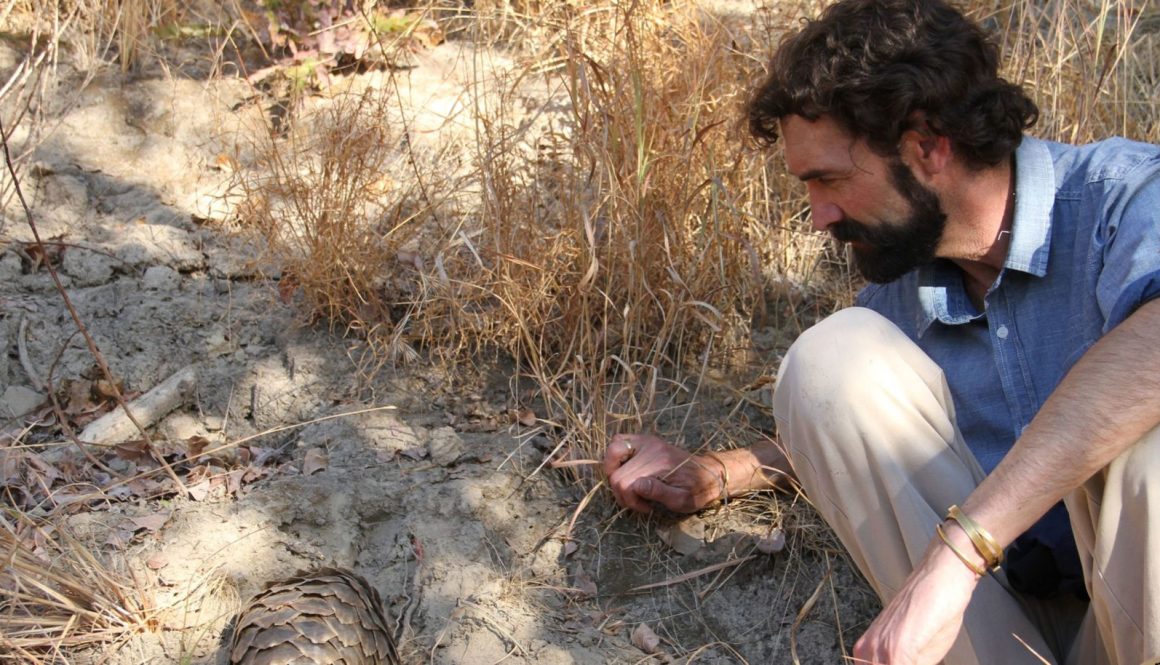
There is an incredible team of people behind the success of Ally’s story, and they need acknowledging. Especially the team on the ground who spend days trying to track down pangolins and without whom we would not have a successful release programme. If you want to know what is involved, watch the Francois in action here
Thank you to
Francois Meyer, our Limpopo Field Manager,for managing Ally’s release and taking the lead on her monitoring and for all his hard work and research into pangolin behavior.
Níall Beddy and Whitney Fourie for their hard work in the field, their dedicated monitoring work, and for capturing the amazing trail camera footage.
Finally thank you to Professor Ray Jansen. Not only for his dedication and hard work in the recovery of pangolins, but also for his guidance during all aspects of their recovery and release. In honor of his contribution to all our work, Ally’s new pup will be named Ray.
Help us keep track
To help us in our work of tracking released pangolins and learning more about their secretive lives, please contribute towards our tracking equipment.
We value your contribution to our mission to save the most trafficked mammal!
With your help, we have had our best year so far and we have new and exciting plans for the future of our organisation.
You will find our Chairman’s report here. We pride ourselves on transparency, ethics, good governance, kindness to animals and harmony between us humans.
Ray Jansen
Our mentor and friend, Prof Ray Jansen has resigned as the Chairman of the APWG after 12 years at the helm of what has become a remarkable organisation – it started off as a conversation between likeminded individuals in 2009, the organisation was established as an NPO in 2011 and today we have an international reputation and successes that we would not have imagined would be possible.
Ray has been granted Honorary Life Membership with the APWG, so while he steps down from his immediate role as the chairman of our group, he will not be going away anytime soon.
In Rays words:
After 12 years of working with pangolins and 10 years following the establishment of the African Pangolin Working Group (APWG), I have decided to resign as Chairman and Board member and revert back to my focus on academia – my teaching, but more importantly scientific research in the natural world. I have been truly blessed to be a part of such a wonderful, vibrant and active pangolin conservation organisation that is the APWG and, to have support from such an amazing collective of individuals that make up its Board and field staff. More than that, how can one describe the privilege it has been to work with pangolins. They are spiritual, bewitching, mystical and peaceful beings that have taught me much about life and about the joys and horror that is human nature. I have been honoured by the APWG Board with a Life Membership, for which I am truly humbled. As such, I remain part of this incredible organisation and will continue to assist and support where I can. Nicci Wright and Alexis Kriel have been voted collective co-chairpersons of the organisation – I cannot think of two better people to take the APWG through to greater heights as the organisation currently experiences a growth phase. I remain active and committed to my pangolin research with my postgraduate students and hope to continue for many years to come.
Our work
Our work spans the fields of intelligence operations, confiscations of pangolins from the illegal trade and we are mandated by the South African Government to oversee the high care, rehabilitation of pangolins and their release back into an appropriate wildlife area. We do training for law enforcement, prosecutors, vets and rehabilitation specialists in South Africa and beyond, we work closely with SAPS and the Environmental Inspectorate and our publication of research is extensive.
The African Pangolin Working Group is currently in a growth phase where we are formalising our structure and moving towards an increase in staff. In the last 10 days, we entered into a grant agreement with USAID for combatting pangolin-related wildlife crime in the Great Limpopo Transfrontier Conservation area which spans the borders of South Africa, Mozambique and Zimbabwe. We are in the process of purchasing a vehicle with sponsorship provided by Pangolin Crisis Fund and invitations for projects with artists, photographers and the media come in on a daily basis. Our second International Pangolin Conference will be held in Kruger Park in September and virtually at the same time, with pangolin conservation specialists presenting from across the globe.
We feel excited about the next phase in the life of our organisation. We will continue to grow, to meet the challenges of saving a creature that belongs on this planet and we welcome you to continue to partner with us going forwards.
On 17 September, 2019 at Silver Oaks, Pretoria, members of the Cullinan Stock Theft & Endangered Species Unit, assisted by members from K9 Benoni, Silverton and Law Enforcement Officials from the Gauteng Department of Agriculture & Rural Development also known as the Green Scorpions, and members of the African Pangolin Working Group conducted a sting operation in which a pangolin was offered for sale to an undercover agent.
Four suspects were subsequently arrested and the vehicle they had used to transport the pangolin was seized. At the time of the arrest, the female pangolin was still alive but severely dehydrated and badly compromised. The pangolin died a few days later at the Johannesburg Wildlife Veterinary Hospital due to malnourishment, dehydration and various physical injuries sustained during captivity. The pangolin had suffered severely while it was kept in captivity as its bones and tendons were clearly visible due to emaciation.
Charges
Charges against two of the four suspects were withdrawn by the Director of Public Prosecutions, Pretoria due to insufficient evidence to prove their involvement. Advocate Jeff Nethononda from the Director of Public Prosecutions, Pretoria office, prosecuted the case in the Pretoria Magistrate’s Court where the presiding magistrate was Ms Luut. The investigation led by Sergeant Morné Kemp from Cullinan Stock Theft & Endangered Species Unit, worked hand in glove with the National Prosecution Authority (NPA) to secure a successful prosecution and conviction.
Professor Jansen, attached to the Faculty of Science at the Tshwane University of Technology in Pretoria, and the founder and Chairman of the African Pangolin Working Group, testified in aggravation that the illegal trade in pangolins makes them the world’s most trafficked mammal. Professor Jansen testified that pangolins are ant eaters, have no defence mechanism and are totally harmless. He further testified that pangolins, globally, are critically endangered and close to being extinct in the near future.
Sentencing
On March 15, 2021, the 2 accused were found guilty and sentencing handed down by the Pretoria Magistrate’s Court on May 19, 2021 as follows:
Accused 1: Orateng Mekwe, a South African citizen, was sentenced to 10 years direct imprisonment without the option of a fine for Contravening Sec 57(1) of National Environmental Management Biodiversity Act 10 of 2004 and for carrying out a restricted activity pertaining to the illegal trade of Pangolins.
Accused 2: Jealous Rungano, a Zimbabwean citizen, was sentenced to 3 months imprisonment and to be deported back to Zimbabwe i.t.o Sec 49(1)(a) of Immigration Act 13 of 2002.
They were both declared unfit to possess a firearm i.t.o Sec 103 of the Firearms Control Act 60 of 2000. Application for leave to appeal was granted.
A clear message
Part of the magistrate’s judgment was that a clear message must be sent to poachers that the illegal trade of wildlife will not be tolerated, just like rhinos, the pangolins and all other wildlife species need to be protected for future generations to appreciate.
The NPA welcomed the sentence as it is the highest sentence ever imposed upon conviction of pangolin poaching in South Africa.
The African Pangolin Working Group’s Chairman, Professor Jansen says that this sentence not only sets a South African and an African continental precedence but also a global precedence for the highest jail sentence given to a pangolin poacher.
On Thursday 13 May 2021 we took part in a very enjoyable panel discussion hosted by Struik Nature (an imprint of Penguin Books) and Richard Peirce, author of Pangolins: Scales of Injustice
While we did not get to all the questions posed before the event, or all the questions asked by viewers, we did get to chat about our work, the pangolins we work with, and how they are individuals with distinct personalities who display a range of human-comprehensible emotions.
Watch this fascinating talk here:
If you would like to support the work we do for pangolins, please donate through one of our many options.
In addition, if you are in South Africa, please register for a My School card, nominate the African Pangolin Working Group as your beneficiary and swipe it wherever you can.
Join environmental activist, author and broadcaster, Richard Peirce, as he chairs a panel discussion about pangolins and their survival.
Pangolins rescued from traffickers come in all shapes, sizes and states of health.
Do the rehabilitators ever feel like giving up?
How much of their hearts do they give to these animals?
What’s so special about pangolins?
What new and exciting pangolin facts are the scientists uncovering?
Would it matter if the world’s most trafficked mammal became extinct?
Why do humans fall in love with a miniature armoured vehicle with a long tongue?
What does it feel like to sit in a vehicle with a loaded pistol on the seat beside you waiting for a sting operation to go down?
Panelists:
Professor Ray Jansen, founder and chairman of the African Pangolin Working Group, a non-profit organisation dedicated to the conservation of Africa’s four pangolin species.
Dr Karin Lourens, Founder-director and head veterinarian of the Johannesburg Wildlife Veterinary Hospital, passionate about conservation and the foremost expert in the treatment and rehabilitation of Temminck’s pangolin.
Nicci Wright, wildlife rehab specialist with over 20 years of wildlife rehabilitation experience; Executive Director of the African Pangolin Working Group; Wildlife Project Manager of the Humane Society International-Africa and Director of the Johannesburg Wildlife Veterinary Hospital.
Dr Wendy Panaino, nearing completion of her PhD on Temminck’s pangolin in the Kalahari, Wendy is also a project manager on the Kalahari Endangered Ecosystem Project,
Simon Naylor, Conservation Manager for &Beyond Phinda Private Game Reserve. Simon has been involved in pangolin conservation since May 2019.
Introduction and Closing by Mdu Ntuli, a South African interviewer, speaker and podcaster (Mdu’s Mike)
There will be a question and answer session after the discussion. You can send through questions in the Zoom chat function during the talk, or you can send them ahead of time via the email address provided on registration.
We are always blown away by the generosity of people who discover pangolins and decide to join the struggle to stop them being wiped off the face of the earth. Gillian Condy is one such person.
Born in Kenya, Gillian went to primary school in Uganda before her family moved to the UK. There, she received her Masters in botanical illustration from the Royal College of Art, London. Africa worked its special magic and she returned to work for International Voluntary Services and Dept. of Education in Botswana before being offered a job by The Botanical Research Institute, now the South African National Biodiversity Institute as the resident botanical illustrator. This was a job she would hold for 34 years before retiring.
Gillian has been an active freelance artist for 40+ years and teacher for 25, with over 140 international exhibitions and a string of awards to her name. She has illustrated botanical books and designed postage stamps for Botswana and South Africa. She is a member of the South African and American Botanical Artists Associations.
Artist in Residence in pangolin country
In November 2017, Gillian was appointed ‘Artist in Residence’ at the Tswalu Kalahari Private Nature Reserve and made eight trips to the reserve to illustrate the plants over the next 14 months. In addition to plants, Gillian painted some of the animals she encountered at Tswalu.
If you are in Johannesburg, Gillian’s glorious paintings are on exhibition at the Circa Gallery at Everard Read, Keys Ave, Rosebank. The Exhibition is on until 13 March 2021 and entrance is free, all you need is a face mask.
The painting of P4 by Gillian which is ours to sell.
Included in the exhibition are two paintings of pangolins, one is sold and the other, marked NFS (not for sale), is ours! Kindly donated by Gillian to raise funds for our work. At a future date we hope to auction this beautiful, poignant pangolin portrait to the highest bidder. Of course, if someone out there would like to make us a ridiculously generous offer, we might be willing to part with it without all the bidding malarkey! (contact us if you feel you just HAVE to own the painting). You can download Gillian’s exhibition catalogue hereto get some idea of the value of her paintings and to marvel in some of the wonderful work she does.
Researchers at Tswalu have used radio telemetry for the past five years to help understand how Temminck’s ground pangolin in the Kalahari cope in their current (and future) environment. This is how Gillian describes her first pangolin encounter in the company of Wendy Panaino, Tswalu’s resident researcher:
At Tswalu I had the amazing opportunity to accompany Wendy Panaino on a number of excursions at night to connect with her research Pangolins. I was totally captivated by these special creatures. The more I learnt about them and their plight, the more angry I became. There is little I can personally do but hoped I could raise some funds towards the wonderful work being done by the (African) Pangolin Working Group.
The illustration was done from one of my photographs of P4, one of Wendy’s friendliest males, who just posed for us, and then walked between us and off into the night.
One of life’s very special moments. Sadly he is no longer with us.
Limited edition prints
If you can’t wait for us to organise the auction, you can own a limited-edition print of the painting almost immediately. The prints are archival quality, printed by Silvertone in Johannesburg, numbered and signed by Gillian and selling at R3500.00 each. There will only be 20 of these 37 x 47 cm prints available. Gillian reports that she has already sold a few of them, and some will be made available at the small gallery at Tswalu, which boils down to very limited numbers being available from the artist. Gillian will only be recouping the cost of printing from the sales, with the majority of the money coming to the African Pangolin Working Group.
To get your pango-loving claws on a print, email Gillian who will only send through her banking details if there is a print available. The price excludes postage and packaging, which will have to be arranged before payment is made.
The following article appeared in Wired magazine, in print and online on October 10, 2020. It was written by Sabrina Weiss and the photos are by Julien Faure. The original article can be found here
Pangolin scales are a prized ingredient in traditional Chinese medicine – and that has put the animal firmly on the endangered list. Isoscape tracking could help stop their slaughter at the source
Pangolins are thought to have passed the coronavirus to humans, after they first caught it from horseshoe bats
Before researchers suggested pangolins may be a missing link in the transmission of coronavirus from bats to humans, most people had never even heard of them. Yet these scaly, ant-eating mammals are smuggled in huge numbers to Asia and are in danger of extinction.
There are eight species of pangolin, split evenly between Africa and Asia, and each one of them is barred from international trade. So identifying confiscated scales and body parts as “pangolin” can be enough to prosecute a criminal case. But discerning different species and tracing their geographic origins is more tricky. This is where wildlife forensics comes in, a rapidly developing field that uses scientific procedures to investigate crimes against wildlife. To help crack down on intricate trafficking routes and poaching hotspots, scientists and laboratory technicians are figuring out ways to analyse the DNA and dietary history of seized animals and their products.
Pangolin scales are a booming business in Asia thanks to their status as an ingredient in traditional Chinese medicine, while the animal’s meat is considered a delicacy Julien Faure / INSTITUTE
Most consumers come from mainland China and Vietnam, where pangolin meat is a prized delicacy and keratin scales are a popular ingredient in traditional Chinese medicine, touted as a cure for anything from asthma to cancer, and as an aid to help mothers with lactation. Pangolins have recently been in the spotlight for their potential role in the Covid-19 pandemic. Sars-Cov-2, the virus that causes the novel disease, is suspected to have originated in horseshoe bats and possibly leaped to humans via pangolins.
On the 5, November 2020, the Mail & Guardian’s environmental reporter Sheree Bega filed the following story about our work.
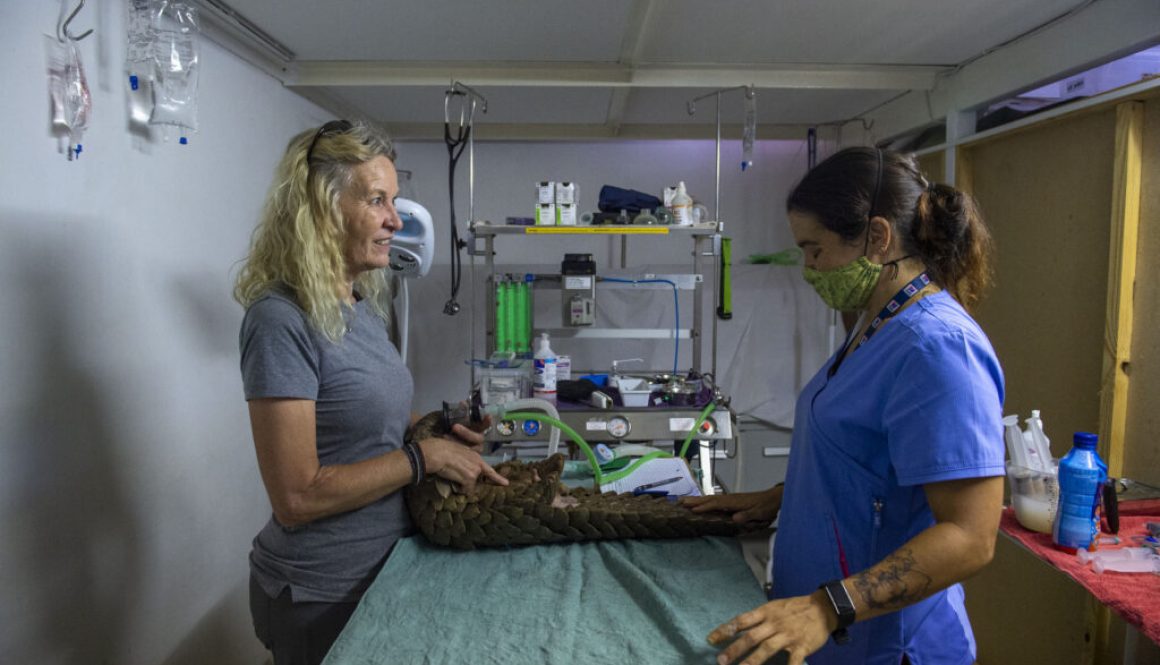
Nicci Wright gently pushes a syringe filled with warm kitten formula into Tot’s tiny, waiting mouth. The 50-day-old Temminck’s ground pangolin’s thin long tongue slurps it up.
“She loves it and she is really thriving,” says Wright, a wildlife rehabilitation specialist and founder-director of the Johannesburg Wildlife Veterinary Hospital, holding the baby protectively in her arms. “She is so special.”
There are six other poached pangolins — the world’s most trafficked mammal – in the hospital receiving treatment. Like Tot’s mother, Tater, these pangolins rescued from the illicit trade in their body parts spent days or even weeks without food and water before they arrived in the hospital’s healing hands.
“They are highly stressed, malnourished, dehydrated and often injured when they get here.”
Wright struggles to remember each pangolin’s individual case. “We’ve done so many that they are blurring into each other. The trade has definitely increased during the lockdown.”
All eight species of endangered pangolins — four in Africa and four in Asia — are trafficked largely for their scales, used in some traditional Chinese medicines. Pangolin meat, too, is prized as a delicacy in China and Vietnam.
Seized endangered pangolin scales are seen during a press conference at the Kwai Chung Customhouse Cargo Examination Compound in Hong Kong on september 5, 2018. – The Hong Kong Customs and the Agriculture, Fisheries and Conservation Department (AFCD) from June to August 2018 mounted Operation Defender against the smuggling of endangered species at the airport, seaport, land boundary and railway control points into the territory. Some 118 cases were reported during the operation period resulting in the seizure valued at 2.4 million USD, with 82 arrests made. (Photo by ISAAC LAWRENCE / AFP)
The enigmatic, little-known mammals are so threatened that the amount they fetch on the black market cannot be publicised to avert fuelling the trade.
The rescued pangolins are treated at the hospital but kept at a secret location to deter potential poachers.
In July, the police’s stock theft and endangered species unit, working with the African Pangolin Working Group, retrieved Tot’s pregnant mother in a sting operation at a mall in Rustenburg.
She was taken to KwaZulu-Natal in October to begin her soft release programme in the wild, but had complications and is back in the hospital.
“It’s stressful work because they all need treatment, they all need care and need to walk every day and night so we’ve got to find seven extra people to walk them.”
Pangolins don’t eat in captivity and have to be walked for hours to forage on ants and termites as they would naturally.
They are shy, cryptic animals. “It’s been difficult to fight for pangolins or to feel for pangolins because most people don’t know what a pangolin is even though they’ve been around for 84 million years.”
Wildlife vet Dr Karin Lourens, also a founder of the hospital, has become a specialist pangolin vet “because we’ve all been forced to know as much as we can about them,” says Wright.
“Our success rate in treating them is about 80%. We know a lot more about them, it’s still not enough, but it makes us feel more reassured and confident in treating them.”
Lourens says that tackling demand for pangolin body parts is crucial. “I’m optimistic because we are catching more I think, maybe because people are aware, the police are more aware and the judicial system is more aware. Seeing them released is wonderful and most of them that we can follow are doing well. The ones who have died in the field have died of natural cases, by being stomped by an elephant or eaten by a crocodile.”
Tackling South Africa’s illicit trade in pangolins
Not a day goes by that professor Ray Jansen’s phone doesn’t ring — either it’s a pangolin syndicate or a case involving the pangolin trade.
“I put it out there in the bush telegraph. When I hear of a pangolin then I pass my alias on,” says the chairperson of the African Pangolin Working Group.
“I get a WhatsApp that says, ‘Hi sir.’ Then I ask, ‘Can I help you?’ They say, ‘You want a pangolin.’ I tell them I’m interested but this is what I want. That’s how it starts.”
Rescued from illegal traders, the animals are often ill and need treatment before they can be released.
But the poaching syndicates, he says, are on to him. “I’ve changed my alias twice. Last week we lost two cases because my cover was blown, possibly a third. Those pangolins unfortunately probably died in the trade.”
“It tells me that it’s now moved into organised crime and that they are all networking with one another. We’re finding it increasingly difficult to catch them. They’re becoming very shrewd and clued up on how we work.”
Jansen leads a 35-strong unit, which he quips is “probably the largest counter poaching unit for one species”, comprising police stock theft and endangered species units and canine units, the Gauteng Green Scorpions, the US department of homeland security and other covert operatives.
This year, they’ve retrieved 36 animals out of the trade — that was last year’s total. Around 90% of the trade, however, goes undetected — pushing a species already on the brink closer to extinction.
“There’s this perception that these pangolins are worth huge amounts of money. We’re finding huge amounts of illegal contraband. I’ve been offered uncut diamonds and rhino horn twice from the same syndicates trying to sell me pangolins.”
Pangolins at the Johannesburg Wildlife Veterinary Hospital NPC which specialises in the treatment and rehabilitation of indigenous wildlife
The rise in pangolin poaching, he believes, has been spurred by the Covid-19 pandemic. “We’ve seen a surge in opportunistic poaching around southern Africa and South Africa where people have lost their jobs, lost their sources of income, especially in the tourism areas.”
Those smuggling the endangered animals into South Africa are often impoverished and destitute. “They are casualties of this war. The middlemen are organised crime and those are the guys we need to nail. They’re the ones creating the market.”
More and more, there are victories. “We’ve gotten jail sentences of eight years in recent months. These get noticed and serve as a massive deterrent.”
“We’re dealing with a species that are going extinct and we need to fight this on every level, not just on the ground in car parks around Jo’burg and Pretoria, but also in the courts.”
What’s being done
The Chinese government has upgraded the status of pangolins to class 1 — the highest level of protection. Pangolin scales have been removed from the country’s official list of ingredients approved for use in traditional Chinese medicine. But loopholes remain, says Jansen.
Some studies have linked pangolins to the coronavirus infection, but Jansen says it “doesn’t matter what the smoking gun is”.
He agrees with a recommendation from a new major report on pandemics and biodiversity by the Intergovernmental Science-Policy Platform on Biodiversity and Ecosystems (Ipbes) to reduce or remove species in the wildlife trade that are identified as high-risk of disease emergence — like pangolins.
John Scanlon, the former secretary-general of the UN-affiliated Convention on International Trade in Endangered Species (CITES), says that pangolins may be a source of the transmission of the coronavirus. “They were put on CITES Appendix 1 in 2016, often called CITES’ highest level of protection. Yet from 2016-2019, we saw a record 206 tonnes of pangolin scales confiscated. CITES listing did not result in better protection of this extraordinary animal, rather illegal exploitation has surged, and today it’s the world’s most heavily trafficked mammal.”
CITES, he says, is not capable of combating transnational organised crime. “Such capacity lies with police and customs and other enforcement officials and the agencies representing them.”
Scanlon, who is now the chairperson of the Global Initiative to End Wildlife Crime, says the Covid-19 pandemic “reminds us, albeit in a devastating way, of the interconnected nature of things, most particularly between economies, the environment, and human and wildlife health and welfare. This observation applies equally to the wildlife trade – be it legal, illegal, regulated or unregulated.
“This pandemic has reminded us of what the world’s best scientists have been telling us for some time now – wildlife issues are not just about conservation – they are also about public and animal health, and if we get it wrong, it can have massive global implications.”
Wright’s nature is to be optimistic and she clings to that. “These pangolins that come through the hospital are fortunate because they’ve been extricated from this horrific trade. If you consider that last year there were 97 tonnes of African pangolin scales intercepted going into Asia, that’s tens of thousands of animals. They’ve been on the planet for 84 million years and they’re leaving the planet on our watch.”